

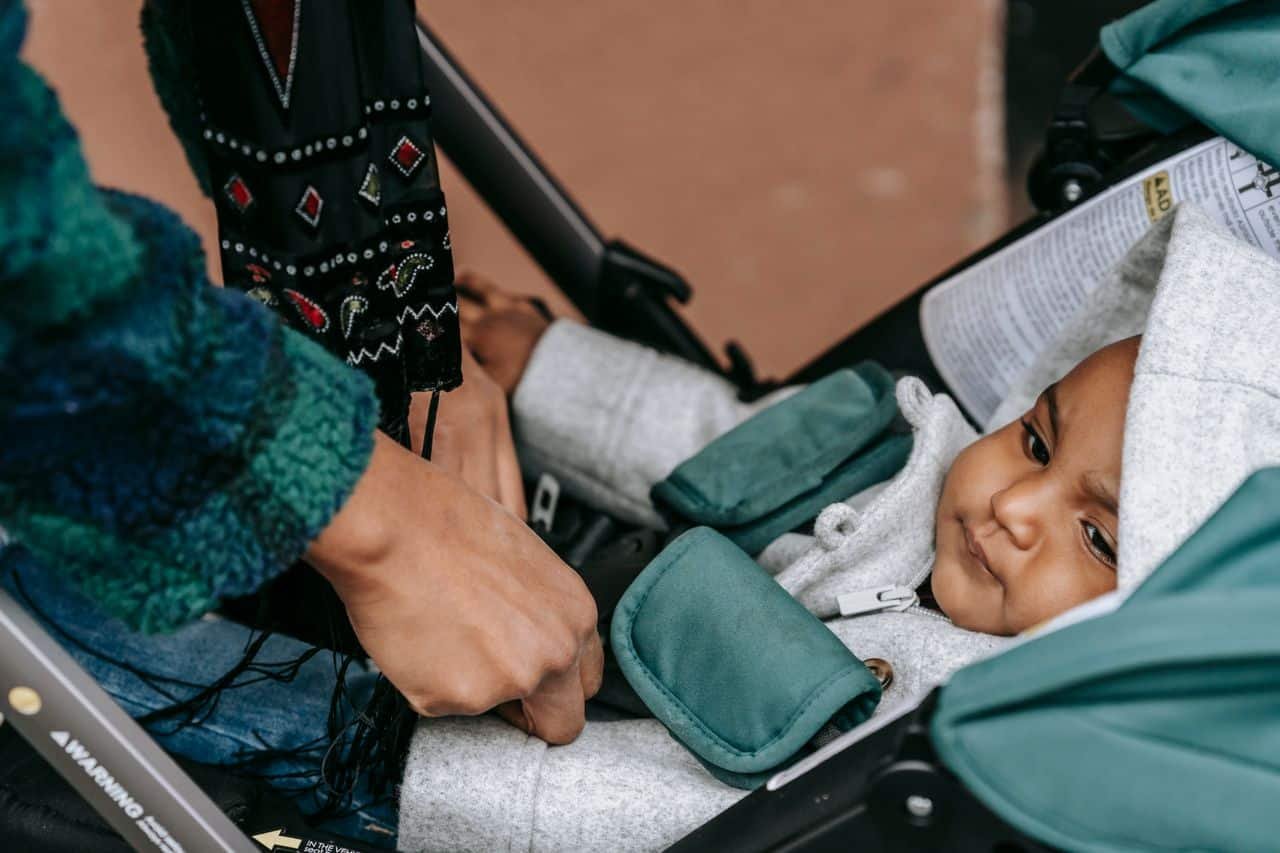
Strollers make everyday life easier, whether you are heading around the block, walking through a park, traveling, or running a quick errand. Because they are used so routinely, it is also easy to skip small checks that help keep a ride predictable and secure.
The good news is that stroller safety does not require a complicated inspection before every outing. A consistent pre-walk routine can take only a short time and can help parents spot common problems involving restraints, brakes, wheels, folding locks, balance, accessories, and child positioning before those issues become more serious.
In the United States, carriages and strollers are covered by a federal safety standard, 16 CFR Part 1227, which incorporates requirements addressing hazards such as stability, brakes, restraint systems, latches and folding mechanisms, structural integrity, and wheels. Those design requirements are important, but day-to-day safety still depends on using the stroller as directed and checking that it remains in good condition.
The following ten checks are designed as a practical routine for parents and caregivers. They are general safety guidance, not a replacement for the instructions that came with your stroller or for advice from your child’s healthcare professional.
| Safety note: Always follow the manufacturer’s instructions for your specific stroller. If a critical component is damaged or a safety recall applies, stop using the stroller until the recommended remedy is completed. |
1. Start With a Quick Recall and Condition Check
A safe walk begins before the stroller moves. Take a few moments to confirm that the stroller has not been recalled and that the parts you depend on are still in good working order. The U.S. Consumer Product Safety Commission (CPSC) maintains a searchable database of recalls and product safety warnings. This is especially useful for secondhand strollers, hand-me-downs, or models that have been stored for a long time.
Next, scan the frame, seat, wheels, restraint straps, buckles, canopy, and attachment points. Look for cracks, loose fasteners, frayed straps, missing parts, unusual movement, or anything that no longer operates as the manufacturer describes. A stroller can look fine at first glance while a loose wheel, damaged latch, or worn restraint is developing into a problem.
If you find damage, do not improvise a repair with tape, string, zip ties, or non-approved replacement parts. Check the manufacturer’s instructions or contact the manufacturer for the correct replacement or repair procedure. The CPSC’s stroller standard specifically addresses hazards involving structural integrity, wheels, brakes, restraints, latches, and folding mechanisms, which is why these areas deserve routine attention.
It is also worth keeping the model name, model number, and purchase information somewhere easy to find. Those details can make it much faster to confirm whether a recall or safety notice applies. If you bought the stroller secondhand and do not have the manual, check the manufacturer’s website for instructions before assuming that every feature or accessory works the same way as another stroller you have used.
2. Confirm the Stroller Is Fully Open and Locked
Folding strollers are convenient because they collapse quickly, but the same joints and hinges that make them portable must be fully engaged before a child is seated. After unfolding the stroller, confirm that the frame is completely open and the locking mechanism has clicked or moved into its proper locked position. Do not assume that a stroller is locked just because it appears open.
Give the handle and frame a gentle stability check before placing your child inside. If the stroller feels loose, begins to fold, or a lock does not engage normally, stop and inspect it. The American Academy of Pediatrics (AAP), through HealthyChildren.org, advises caregivers to securely lock a stroller open before putting a child in it and to keep children away while opening and closing the stroller.
That last point matters because little fingers can be close to hinges, frame joints, and wheels. When folding or unfolding, keep your child at a safe distance until the stroller is fully set up. If another adult is helping, communicate before closing or adjusting the frame so that hands and feet are clear.
After loading the child, look once more at the frame from both sides. Some strollers have more than one latch, release button, or seat-attachment point, and a partially engaged part may not be obvious from behind the handle. This second glance is particularly helpful after travel, storage, or removing and reinstalling a seat, bassinet, or car-seat adapter.
3. Test the Parking Brake Before You Load the Stroller
A parking brake is not only for steep hills. Use it whenever the stroller is stopped and you are not actively controlling its movement, even if the surface looks flat. Before each outing, engage the brake and gently try to move the stroller. The wheels should remain secured according to the stroller’s design.
If the brake pedal feels unusually loose, fails to engage, releases unexpectedly, or does not hold the stroller as it normally does, do not treat that as a minor inconvenience. Brake failures are among the hazards addressed by federal stroller safety requirements. Follow the manufacturer’s instructions for inspection or service before using the stroller again.
When placing a child into or taking a child out of the stroller, set the brake first. The same rule is useful when stopping to adjust clothing, reach into the storage basket, talk with someone, or manage another child. On slopes, ramps, curbs, train platforms, or busy sidewalks, keep physical control of the stroller as well; a parking brake should not replace attentive supervision.
If your stroller has a linked brake that controls more than one wheel, confirm that the full system engages rather than checking only one side. After mud, sand, or debris exposure, inspect and clean the brake area in the way the manufacturer recommends. A brake that works inconsistently deserves attention before the next trip, not after the stroller is already loaded.
4. Check Every Wheel and the Path Ahead
Wheels take constant impact from sidewalks, curbs, gravel, grass, and uneven pavement, so a quick wheel check can prevent an unpleasant surprise. Look for a wheel that is loose, crooked, unusually worn, difficult to rotate, or not securely attached. If your stroller has swivel locks, confirm that they are set appropriately for the terrain and used according to the manufacturer’s instructions.
Also check the route immediately around you. Broken pavement, potholes, wet leaves, loose gravel, steps, steep driveways, and crowded entrances can change how a stroller handles. Slow down before obstacles rather than relying on momentum to push through them. Use ramps and accessible curb cuts when available instead of trying to force the stroller over a high curb.
Jogging strollers deserve extra care because their intended use and configuration may differ from standard strollers. Follow the manufacturer’s age, wheel-lock, restraint, and activity instructions. A stroller that is safe for ordinary walking is not automatically designed for running, and accessories or infant car-seat configurations may have separate limitations.
During the walk, treat changes in steering as a signal to stop and check rather than simply pushing harder. A wheel that suddenly pulls to one side, wobbles, or makes an unfamiliar sound may indicate that something has loosened or become caught. Move to a safe location, apply the brake, and inspect the stroller before continuing.
5. Buckle the Harness Correctly Every Time
The restraint system is one of the most important checks on the list. The AAP recommends a five-point harness with straps over both shoulders, at the hips, and between the legs, and advises using the harness whenever a child rides in the stroller. The CPSC also warns that an unrestrained infant can slide into an opening between the seat and tray or grab bar, creating a serious entrapment or strangulation hazard.
Before moving, make sure every required buckle is connected and each strap follows the correct path. The harness should be adjusted to the child and used exactly as the stroller manufacturer directs. Check that straps are not twisted, trapped under the child, or routed around bulky items in a way that prevents a secure fit.
Do not rely on the tray or bumper bar as a substitute for the harness. A child may lean, stand, twist, or unexpectedly shift position even during a short walk. If the harness has become frayed, a buckle no longer latches properly, or a strap has detached from its anchor point, stop using the stroller until the restraint can be restored correctly.
Bulky coats, blankets, or toys should not prevent the harness from being used as designed. If you add layers for weather, recheck the fit instead of leaving the straps in the previous position. Parents should also make sure older toddlers cannot easily access a release or loosen a strap in a way that defeats the restraint system during the outing.
6. Make Sure the Seat and Configuration Fit Your Child
Strollers are not one-size-fits-all. Before a walk, confirm that the seat, recline position, attachments, and overall configuration are appropriate for your child’s age, size, and developmental stage under the manufacturer’s instructions. Check the stroller’s stated weight and height limits and any separate limits for a bassinet, infant car seat, rider board, second seat, or other approved accessory.
For young infants, head and trunk control are important considerations when choosing a seating position. Use only configurations the manufacturer identifies as suitable for your child. If a stroller accepts an infant car seat, make sure the exact car seat and adapter combination is approved for that stroller and that all connection points are fully engaged before moving.
For toddlers and older children, do not allow standing in a regular stroller seat or climbing on parts that are not designed as riding positions. If the stroller includes a standing platform or second-child feature, stay within its specified limits. The AAP also advises caregivers to be mindful of weight guidelines on strollers designed for an older child to sit or stand in the rear, because excessive movement can affect stability.
If you switch configurations often, such as moving from a bassinet to a seat or adding a second seat, make the configuration check part of the routine rather than relying on memory. Verify adapters, orientation, attachment clicks, and weight limits each time. A setup that worked for one child or one stage may not be appropriate later as children grow.
7. Keep Bags and Extra Weight in the Right Place
A loaded diaper bag may feel harmless hanging from the handle, but weight high on the stroller can change its balance. The AAP specifically advises against hanging bags or other items from stroller handles because they can cause the stroller to tip backward. Use the stroller’s designated storage basket or other manufacturer-approved storage areas instead.
Before leaving, check that items in the basket are within the stroller’s stated load limit and are positioned so they do not interfere with wheels, brakes, folding parts, or your walking stride. Heavy objects are generally more stable when kept low in the approved storage area rather than suspended from the handlebar.
Avoid improvising with large hooks, clips, or aftermarket organizers if they cause the stroller to become unstable or exceed the manufacturer’s instructions. The same principle applies to a child riding where the stroller was not designed to carry one. Stability can change quickly when extra weight is added in the wrong place, especially on a slope or when a child shifts position.
Before setting off, think about what you are likely to add during the trip as well. Groceries, shopping bags, jackets, and water bottles can gradually turn a balanced stroller into an overloaded one. Leaving a little unused storage capacity and placing new items in approved low storage areas can help keep the stroller’s handling more predictable.
8. Check the Canopy, Airflow, Clothing, and Weather
Weather protection should make a walk more comfortable without creating new problems. On sunny days, use the stroller canopy as designed and choose clothing and sun-protection measures appropriate for your child’s age and conditions. On hot days, pay attention to airflow and how your child looks and feels throughout the outing.
Avoid covering the entire stroller with a blanket or other material in a way that restricts ventilation or prevents you from easily seeing your child. A stroller should never become a closed-off space that makes supervision difficult. If you use a rain cover, insect net, sunshade, or weather accessory, make sure it is compatible with the stroller, installed as directed, and does not interfere with breathing space, restraints, moving parts, or visibility.
Conditions can change during a walk. Stop in a safe place if you need to adjust layers, check the child, or reposition a cover. In very hot, cold, stormy, smoky, or otherwise uncomfortable conditions, shortening or postponing the outing may be the better choice. Parents with questions about heat, sun exposure, or a child’s health should follow guidance from their pediatrician or relevant public-health authorities.
A practical habit is to check your child at regular intervals instead of assuming the canopy or weather cover is doing its job. Make sure you can see the child clearly, that the face is unobstructed, and that no fabric or accessory has shifted during movement. Visibility makes it easier to notice discomfort or a positioning problem early.
9. Remove Choking, Strangulation, and Pinch Hazards
Before walking, look at the stroller from your child’s point of view. Loose cords, drawstrings, straps, toys, clips, or accessories can end up close to the face or neck. Keep potentially hazardous cords and dangling items away from the child, and do not tie toys or other objects around a child’s neck or to the stroller in a way that creates a loop or entanglement risk.
Pay attention to small detachable parts as well, especially with older, damaged, or modified equipment. If an accessory is cracked, broken, or shedding small pieces, remove it. Use only accessories that are suitable for the stroller and child, and follow their instructions.
Folding joints and moving parts deserve another quick look whenever the stroller is adjusted. The CPSC’s stroller requirements address hinge and folding hazards, and the AAP recommends keeping children away during opening and closing. Do not let a toddler help fold the stroller or place fingers near hinges, wheel assemblies, seat-adjustment mechanisms, or canopy joints while an adult is operating them.
10. Do a Final 30-Second Pre-Walk Scan
The last check is about turning separate safety habits into a simple routine. Stand behind the stroller and scan from the ground up: wheels secure, brake released only when you are ready to move, frame locked, storage balanced, child positioned correctly, harness buckled, canopy and accessories clear, and the route ahead safe. Keep one hand in control of the stroller when circumstances require it, and stay attentive throughout the walk.
A routine does not need to be complicated to be useful. Repeating the same sequence makes it easier to notice when something is different: a buckle that feels unusual, a wheel with extra play, a bag that has been hung on the handle, or a frame lock that has not fully engaged.
For parents who prefer a more detailed step-by-step routine, Stroller Haven has created a practical Stroller Safety Checklist Before Every Walk that parents can use as an additional reference.
Most importantly, remember that a checklist complements rather than replaces the stroller manufacturer’s instructions. Models vary in their approved ages, configurations, accessories, limits, and maintenance requirements. When there is a conflict, follow the instructions and safety notices for your specific stroller.
Quick Pre-Walk Stroller Safety Checklist
Before you start moving, confirm the following:
- Recall status and visible damage checked
- Frame fully open and locking mechanism engaged
- Parking brake working normally
- Wheels secure and route checked for hazards
- Harness correctly buckled and adjusted
- Seat/configuration appropriate for the child
- Bags and cargo stored only in approved areas
- Canopy and weather accessories allow visibility and airflow
- Loose cords, small parts, and pinch hazards removed
- Final scan completed before moving
Final Thoughts
Stroller safety is less about perfection and more about consistency. The same ten checks repeated before a walk can help parents catch an unlocked frame, an unbuckled harness, a loose wheel, an overloaded handle, or an unsuitable accessory while there is still time to correct it.
Caregivers should also stay informed after purchase. Check safety notices and recalls periodically, use only approved configurations and accessories, and stop using a stroller when a critical part does not work as intended. If a stroller has been involved in a crash, has significant damage, or has an unresolved safety problem, contact the manufacturer for guidance rather than guessing at a repair.
Finally, supervision remains essential. A properly designed and maintained stroller is a helpful transportation tool, but it cannot replace an attentive adult. Buckle the harness, use the brake when stopped, keep the stroller balanced, follow the manufacturer’s limits, and make the quick pre-walk scan part of your normal routine.
About the Author
Stroller Haven Editorial Team creates practical stroller safety guides, comparisons, and educational resources designed to help parents make informed decisions about baby travel gear. The team focuses on clear, parent-friendly information and responsible product-use guidance.
References
These sources were used to support the safety guidance in this article:
- U.S. Consumer Product Safety Commission (CPSC), Carriages and Strollers FAQ
- U.S. Consumer Product Safety Commission (CPSC), Infants in Strollers Must Be Properly Secured at All Times
- U.S. Consumer Product Safety Commission (CPSC), Recalls & Product Safety Warnings
- American Academy of Pediatrics, HealthyChildren.org, How to Choose a Safe Baby Stroller
- U.S. Consumer Product Safety Commission (CPSC), Carriages and Strollers Business Guidance