

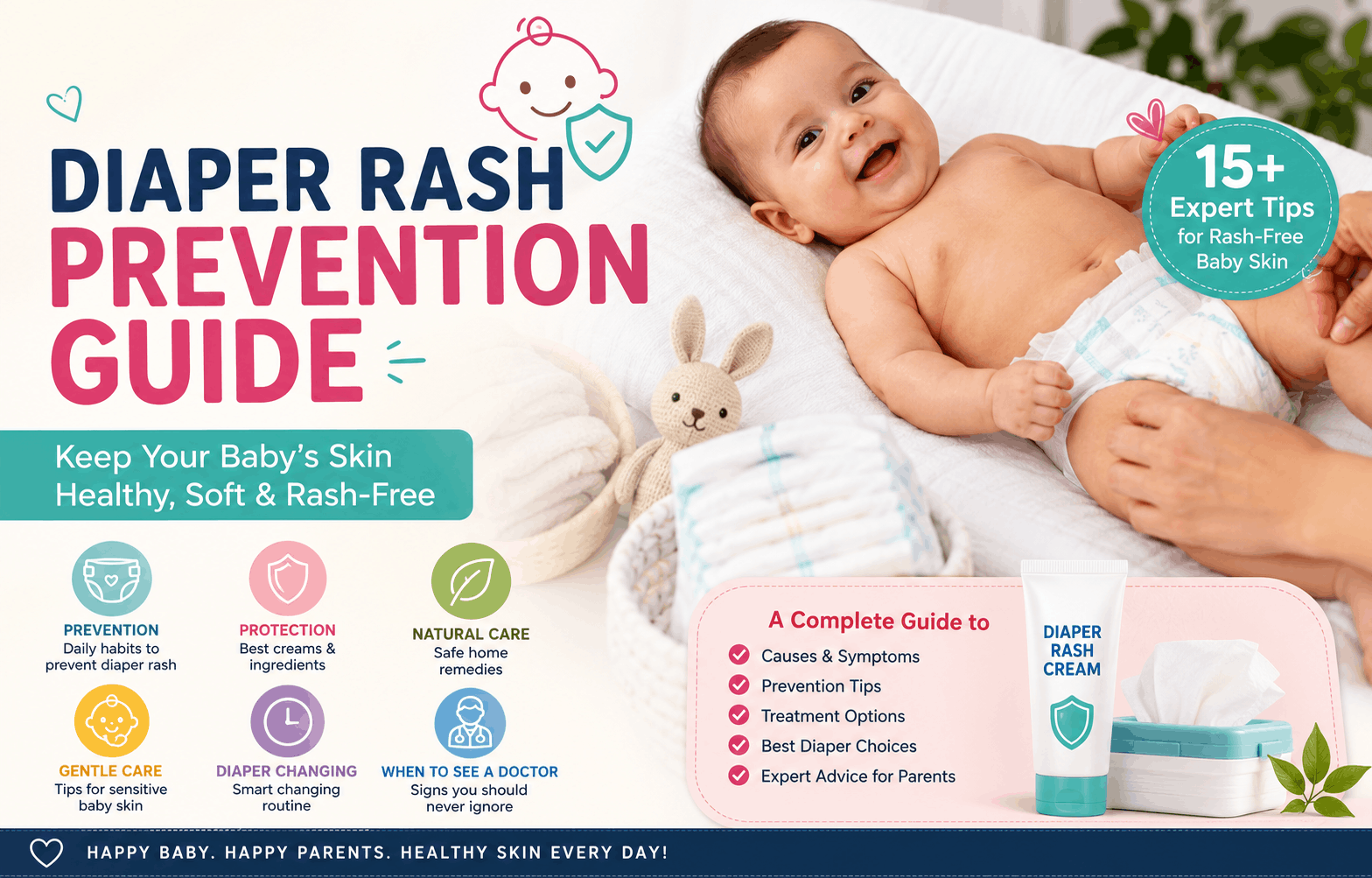
Welcoming a new baby is one of life’s greatest joys, but it also comes with challenges that every parent experiences. One of the most common concerns during infancy is baby diaper rash. While it may look alarming, diaper rash is usually mild and can often be prevented with proper diaper care and a consistent skincare routine.
The good news is that diaper rash prevention is much easier than treating a severe rash. By understanding what causes diaper rash, recognizing the early signs, and following simple diaper-changing habits, you can keep your baby’s delicate skin healthy, comfortable, and rash-free.
Whether you’re caring for a newborn or an active toddler, this comprehensive Diaper Rash Prevention Guide will walk you through everything you need to know—from the most common diaper rash causes and diaper rash symptoms to expert-approved prevention strategies, the best diaper rash cream, home remedies, and when it’s time to consult your pediatrician.
Throughout this guide, you’ll also discover practical tips on how to prevent diaper rash naturally, choosing the right diapers, maintaining proper baby skin care, and creating a daily routine that minimizes irritation.
Quick Tip: Most diaper rashes improve within a few days when parents change diapers frequently, keep the diaper area dry, and apply a protective barrier cream at every diaper change.
If you’re preparing for your baby’s arrival, don’t miss our First Trimester Survival Guide: Symptoms, Diet & Do’s & Don’ts, which helps expecting mothers build healthy pregnancy habits that support both mom and baby. Likewise, once your little one arrives, our upcoming Newborn Baby Care Checklist will be a valuable companion for first-time parents.
What Is Diaper Rash?
Diaper rash, medically known as diaper dermatitis, is an inflammation of the skin covered by a baby’s diaper. It typically appears as red, irritated, or inflamed skin around the baby’s bottom, thighs, genitals, and surrounding areas.
Almost every baby experiences diaper rash at least once during the first two years of life. Since infants wear diapers almost around the clock, their skin is frequently exposed to moisture, urine, stool, and friction—all of which can irritate their delicate skin.
Why Are Babies More Prone to Diaper Rash?
A baby’s skin differs significantly from adult skin in several important ways:
- It is thinner and more delicate.
- It loses moisture more quickly.
- It has a less mature protective barrier.
- It is more susceptible to friction and irritation.
- It reacts more easily to chemicals and fragrances.
When a wet diaper remains against the skin for too long, urine and stool begin to break down into substances that irritate the skin. Combined with friction from diaper movement, this creates the perfect environment for a baby diaper rash to develop.
Mild vs. Severe Diaper Rash
Not all diaper rashes are the same. Understanding the difference helps parents decide whether home care is sufficient or if medical advice is needed.
| Mild Diaper Rash | Severe Diaper Rash |
|---|---|
| Light redness | Bright red skin |
| Small irritated patches | Large inflamed areas |
| Baby remains comfortable | Baby cries during diaper changes |
| Improves within 2–3 days | Persists despite treatment |
| No blisters | Blisters, sores, or bleeding |
| No swelling | Swollen skin or pus |
Recognizing the early signs is one of the easiest ways to practice effective diaper rash prevention before the irritation becomes more serious.
What Causes Diaper Rash?
Understanding the underlying diaper rash causes is the first step in learning how to prevent diaper rash. In many cases, several factors contribute at the same time rather than a single cause.
Let’s explore the most common reasons babies develop diaper rash.
1. Prolonged Moisture Exposure
The leading cause of diaper rash is prolonged contact with moisture.
A wet diaper creates a warm, humid environment where the baby’s skin remains damp for extended periods. This weakens the skin’s natural protective barrier, making it easier for irritation to develop.
Even highly absorbent disposable diapers can become saturated if they aren’t changed frequently enough.
Prevention Tips
- Change diapers every 2–3 hours during the day.
- Check newborn diapers more frequently.
- Always change diapers immediately after bowel movements.
- Allow the diaper area to air dry whenever possible.
Frequent diaper changes remain one of the best ways to prevent diaper rash in babies.
2. Urine and Stool Irritation
Urine alone usually causes minimal irritation. However, when urine mixes with stool, enzymes and bacteria begin breaking down the skin’s protective layer.
Babies with diarrhea are especially prone to diaper rash because their skin comes into contact with more digestive enzymes, which are highly irritating.
This is why pediatricians recommend changing dirty diapers as soon as possible rather than waiting.
3. Friction from Tight Diapers
Another overlooked cause is friction.
A diaper that is too tight continuously rubs against the baby’s skin, especially around the thighs, waist, and groin.
As your baby becomes more active—rolling, crawling, or walking—friction increases, making properly fitted diapers even more important.
Signs the Diaper May Be Too Tight
- Red marks around the legs
- Waist indentations
- Difficulty fastening the diaper
- Frequent rubbing around the thighs
Choosing the correct diaper size is an important part of baby diaper care.
4. Sensitive Skin
Some babies naturally have more sensitive skin than others.
Babies with eczema, dry skin, or a family history of allergies may develop diaper rash more easily.
Even mild soaps, scented wipes, lotions, or detergents can trigger skin irritation in sensitive babies.
If your baby has delicate skin, choose:
- Fragrance-free wipes
- Dye-free diapers
- Gentle baby cleansers
- Hypoallergenic laundry detergents
Maintaining a simple baby skin care routine helps reduce unnecessary irritation.
5. Yeast (Candida) Infection
Sometimes what appears to be a regular diaper rash is actually a fungal infection.
A yeast diaper rash develops when the fungus Candida albicans grows excessively in the warm, moist diaper environment.
Yeast infections often occur:
- After antibiotic use
- Following prolonged diaper rash
- During frequent diarrhea
- When skin stays moist for long periods
Signs of a Yeast Diaper Rash
- Bright red rash
- Raised borders
- Small red bumps around the edges (satellite lesions)
- Rash that spreads into skin folds
- Doesn’t improve with regular diaper rash cream
Unlike simple irritation, a fungal diaper rash usually requires an antifungal cream prescribed or recommended by a healthcare professional.
6. Antibiotic Use
Antibiotics kill harmful bacteria, but they can also reduce the beneficial bacteria that normally keep yeast growth under control.
As a result, babies taking antibiotics—or breastfed babies whose mothers are taking antibiotics—may develop a fungal diaper rash more easily.
If your baby is prescribed antibiotics, pay extra attention to diaper hygiene and monitor for signs of irritation.
7. Introducing Solid Foods
Many parents notice diaper rash shortly after introducing solid foods.
This isn’t a coincidence.
As babies begin eating fruits, vegetables, cereals, and other foods, the composition and acidity of their stool changes.
Acidic foods such as:
- Tomatoes
- Citrus fruits
- Strawberries
- Pineapple
may temporarily increase skin irritation in some babies.
This doesn’t necessarily mean these foods should be avoided. Instead, monitor your baby’s skin and change diapers more frequently when introducing new foods.
8. Diarrhea
Diarrhea is one of the strongest risk factors for diaper rash.
Frequent bowel movements expose the skin to digestive enzymes that rapidly damage the outer skin barrier.
Parents should be especially vigilant during stomach infections or when babies are teething and experiencing looser stools.
Changing diapers immediately after every bowel movement is one of the simplest diaper rash prevention tips for first-time parents.
9. Reaction to New Products
Occasionally, diaper rash develops after switching to a new product.
Potential triggers include:
- New diaper brands
- Baby wipes
- Laundry detergent
- Baby lotions
- Bubble baths
- Fabric softeners
If the rash appears shortly after introducing a new product, consider switching back to the previous one and observe whether the irritation improves.
Can Teething Cause Diaper Rash?
Many parents wonder, “Can teething cause diaper rash?”
Current medical evidence suggests that teething itself does not directly cause diaper rash. However, some babies produce more saliva during teething and may experience changes in bowel habits or mild diarrhea. These changes can increase moisture and skin irritation in the diaper area, making a rash more likely.
If your baby is teething, focus on frequent diaper changes, gentle cleansing, and applying a barrier cream to protect the skin.
Signs & Symptoms of Diaper Rash + 15 Best Ways to Prevent Diaper Rash

Recognizing the diaper rash symptoms early is the best way to stop a mild irritation from becoming a painful rash. Most diaper rashes start with slight redness and can improve quickly with proper care. However, if ignored, they may worsen and even lead to a yeast diaper rash or bacterial infection.
Here are the most common signs to watch for:
Signs and Symptoms of Diaper Rash
1. Red or Pink Skin
This is usually the first and most noticeable symptom. The skin around your baby’s bottom, thighs, or genital area may appear slightly pink or bright red.
2. Warm or Inflamed Skin
The affected area may feel warmer than the surrounding skin due to inflammation.
3. Dry or Peeling Skin
Mild diaper rash may cause the skin to become dry, flaky, or slightly rough.
4. Small Red Bumps
Tiny bumps or raised spots may appear, especially if the rash is becoming irritated.
5. Fussiness During Diaper Changes
If your baby cries or becomes uncomfortable when you clean the diaper area, it may indicate skin irritation.
6. Blisters or Open Sores
These are signs of a more severe diaper rash and should not be ignored.
7. Rash Inside Skin Folds
A rash that extends into the skin folds with bright red patches and tiny “satellite” bumps may indicate a fungal diaper rash caused by yeast.
15 Best Ways to Prevent Diaper Rash
The following tips are recommended by pediatricians and child health experts to help parents understand how to prevent diaper rash naturally while maintaining a healthy baby skin care routine.
Tip #1: Change Diapers Frequently
The simplest and most effective diaper rash prevention strategy is frequent diaper changes.
Leaving a wet or dirty diaper on for too long exposes your baby’s skin to moisture, urine, and stool, all of which can break down the skin’s natural barrier.
How Often Should You Change Baby’s Diaper?
- Every 2–3 hours during the day.
- Immediately after every bowel movement.
- Before bedtime.
- As soon as your baby wakes up.
- More frequently if your baby has diarrhea.
For newborns, you may need to change diapers 8–12 times a day, while older babies typically need 6–8 diaper changes daily.
Pro Tip: Don’t rely solely on a diaper’s wetness indicator. Regularly check the diaper, especially during hot weather or long outings.
Tip #2: Clean the Diaper Area Gently
Cleaning your baby’s skin properly is just as important as changing diapers frequently.
Avoid rubbing the skin aggressively, as friction can worsen irritation.
Best Cleaning Practices
- Use lukewarm water whenever possible.
- Choose fragrance-free, alcohol-free baby wipes.
- Wipe gently from front to back.
- Avoid scrubbing.
- Clean all skin folds carefully.
If your baby already has a rash, rinsing with warm water instead of wipes for a few diaper changes may help reduce irritation.
Gentle cleaning plays a major role in baby diaper care and supports long-term diaper rash prevention.
Tip #3: Pat the Skin Completely Dry
Many parents unknowingly trap moisture by putting on a new diaper before the skin is completely dry.
Moisture weakens the skin barrier and encourages irritation.
What You Should Do
- Pat the skin dry using a soft towel.
- Never rub the skin.
- Let the area air dry for a minute or two before putting on a fresh diaper.
Even a few extra seconds of drying can significantly reduce the risk of newborn diaper rash.
Tip #4: Give Your Baby Diaper-Free Time
Fresh air is one of the best natural remedies for healthy skin.
Allowing your baby to spend a few minutes without a diaper helps moisture evaporate and reduces friction.
How Much Diaper-Free Time Is Enough?
Aim for 10–20 minutes, two or three times a day.
You can place your baby on:
- A waterproof mat
- A soft towel
- A washable play mat
This simple habit is one of the easiest ways to prevent diaper rash naturally.
Tip #5: Apply a Barrier Cream at Every Diaper Change
Barrier creams create a protective layer between your baby’s skin and moisture, reducing the chances of irritation.
For babies with sensitive skin or recurring rashes, applying a diaper rash cream at every diaper change can make a noticeable difference.
Look for Ingredients Like:
- Zinc oxide
- Petroleum jelly
- Panthenol
- Lanolin
These ingredients help protect the skin while supporting natural healing.
ParentingFinds Tip: Even if your baby doesn’t currently have a rash, using a thin layer of barrier cream can help with diaper rash prevention, especially overnight or during long car rides.
We’ll discuss the best diaper rash cream ingredients and recommended products in Part 3 of this guide.
Tip #6: Choose the Right Diaper Size
A diaper that’s too tight can rub against your baby’s skin, while one that’s too loose may leak and allow prolonged moisture exposure.
Signs the Diaper Fits Correctly
- Snug but not tight.
- No deep red marks around the waist or thighs.
- Enough room to fit two fingers comfortably under the waistband.
- Minimal leaks.
As your baby grows, regularly check the diaper size rather than sticking to the same size based on age alone.
Choosing the right fit is one of the most overlooked diaper changing tips.
Tip #7: Avoid Overly Tight Diapers
Parents sometimes fasten diapers too tightly to prevent leaks, but this can actually increase friction and trap heat.
Instead:
- Fasten the diaper securely without squeezing the skin.
- Allow air circulation.
- Ensure the diaper moves comfortably with your baby’s body.
Better airflow means less moisture, making this a simple yet effective diaper rash prevention tip.
Tip #8: Choose Breathable, Highly Absorbent Diapers
Not all diapers are created equal.
Modern disposable diapers are designed to wick moisture away from the skin, helping keep babies dry for longer periods.
When shopping for diapers, look for:
- High absorbency.
- Soft, breathable materials.
- Stretchable sides.
- Good leak protection.
- Fragrance-free options if your baby has sensitive skin.
For parents using cloth diapers, ensure they are changed more frequently to prevent moisture buildup. We’ll compare cloth diapers vs disposable diapers for diaper rash prevention later in this guide to help you decide which option suits your family best.
Tip #9: Wash Cloth Diapers Properly
If you’re using cloth diapers, proper washing is just as important as frequent diaper changes. Residual detergent, fabric softener, or bacteria left behind after washing can irritate your baby’s sensitive skin and increase the risk of baby diaper rash.
Best Practices for Washing Cloth Diapers
- Rinse soiled diapers immediately.
- Wash with a baby-safe, fragrance-free detergent.
- Avoid fabric softeners, as they reduce absorbency.
- Run an extra rinse cycle to remove detergent residue.
- Dry diapers completely before reuse.
- Replace worn-out inserts that no longer absorb moisture effectively.
Clean cloth diapers can work just as well as disposable diapers when maintained properly. If you’re unsure which option is best, we’ll compare cloth diapers vs disposable diapers for diaper rash prevention later in this guide.
Tip #10: Choose Fragrance-Free Baby Wipes
Baby wipes are convenient, but some contain alcohol, artificial fragrances, or harsh preservatives that may irritate delicate skin.
For babies with sensitive skin or recurring diaper rashes:
- Choose alcohol-free wipes.
- Select fragrance-free varieties.
- Look for dermatologically tested products.
- Consider using soft cotton pads with warm water during severe diaper rash episodes.
Gentle cleansing is an essential part of any baby skin care routine to avoid diaper rash.
Tip #11: Introduce New Foods Gradually
As babies begin eating solid foods, their stool changes in consistency and acidity. Some foods can temporarily make bowel movements more irritating to the skin.
Common foods that may contribute to irritation include:
- Tomatoes
- Citrus fruits
- Pineapple
- Strawberries
This doesn’t mean these foods should be avoided entirely. Instead:
- Introduce one new food every few days.
- Watch for digestive changes.
- Monitor your baby’s skin.
- Increase diaper changes if stools become more frequent.
This simple habit can significantly support diaper rash prevention for newborns transitioning to solids.
Tip #12: Change Dirty Diapers Immediately
While wet diapers can wait briefly if your baby is asleep, a soiled diaper should always be changed as soon as possible.
Stool contains digestive enzymes that begin irritating the skin almost immediately.
Why Immediate Changes Matter
- Reduces exposure to bacteria.
- Prevents prolonged moisture.
- Lowers the risk of yeast infections.
- Helps maintain healthy skin.
One of the easiest answers to “How often should you change baby’s diaper?” is:
- Every 2–3 hours during the day.
- Immediately after every bowel movement.
- Before bedtime.
- Immediately after waking up.
Tip #13: Prevent Overnight Moisture
Many babies sleep for longer stretches at night, meaning they stay in the same diaper for several hours.
Choosing the right overnight routine is an important part of diaper rash prevention at night.
Overnight Prevention Tips
- Use highly absorbent overnight diapers.
- Apply a thick layer of barrier cream before bedtime.
- Ensure the diaper fits properly without being tight.
- Change immediately after waking.
If your baby frequently wakes with damp clothing or a saturated diaper, consider sizing up overnight diapers after consulting the manufacturer’s sizing guide.
Tip #14: Skip Baby Powder Unless Recommended
Baby powder used to be a common diaper-changing product, but most pediatricians no longer recommend routine use.
Why?
Powder particles can become airborne and be inhaled by babies, potentially irritating their lungs. Powders also do little to protect against moisture compared to barrier creams.
Instead of powder, use:
- Zinc oxide creams
- Petroleum jelly-based ointments
- Gentle moisturizing barriers
These products provide far better protection against moisture and friction.
Tip #15: Don’t Ignore Early Redness
One of the biggest mistakes parents make is waiting until a rash becomes severe before taking action.
The moment you notice:
- Slight redness
- Mild irritation
- Increased fussiness during diaper changes
Start preventive care immediately:
- Increase diaper changes.
- Allow diaper-free time.
- Apply a protective diaper rash cream.
- Keep the area clean and dry.
Treating early redness often prevents a mild irritation from becoming a painful severe diaper rash.
Recommended Diaper Rash Creams Available on Amazon
If you’re looking for a reliable diaper rash cream, here are some popular options that parents frequently choose. Always check the ingredient list and consult your pediatrician if your baby has persistent or severe rashes.
1. Himalaya Diaper Rash Cream
A popular option among Indian parents.
Highlights:
- Contains aloe vera
- Gentle herbal ingredients
- Suitable for everyday use
- Budget-friendly
Buy on Amazon
2. Sebamed Baby Rash Cream
Suitable for babies with extra-sensitive skin.
Benefits
- pH-balanced formula
- Dermatologically tested
- Supports skin barrier repair
Buy on Amazon
3. Cetaphil Baby Diaper Cream
Known for its gentle formulation.
Features
- Hypoallergenic
- Fragrance-free
- Helps soothe irritated skin
- Suitable for newborns
Buy on Amazon
How to Apply Diaper Rash Cream Correctly
Many parents apply too little cream or rub it into the skin like a lotion. Barrier creams work differently.
Step 1
Clean the diaper area gently using warm water or fragrance-free wipes.
Step 2
Pat the skin completely dry.
Step 3
Apply a thick, even layer of diaper rash cream over the irritated area. There’s no need to rub it in completely—a visible layer acts as a protective shield.
Step 4
Fasten a clean diaper comfortably, ensuring it isn’t too tight.
For babies with frequent irritation, applying a barrier cream at every diaper change can be one of the best ways to prevent diaper rash in babies.
Cloth Diapers vs Disposable Diapers for Diaper Rash Prevention
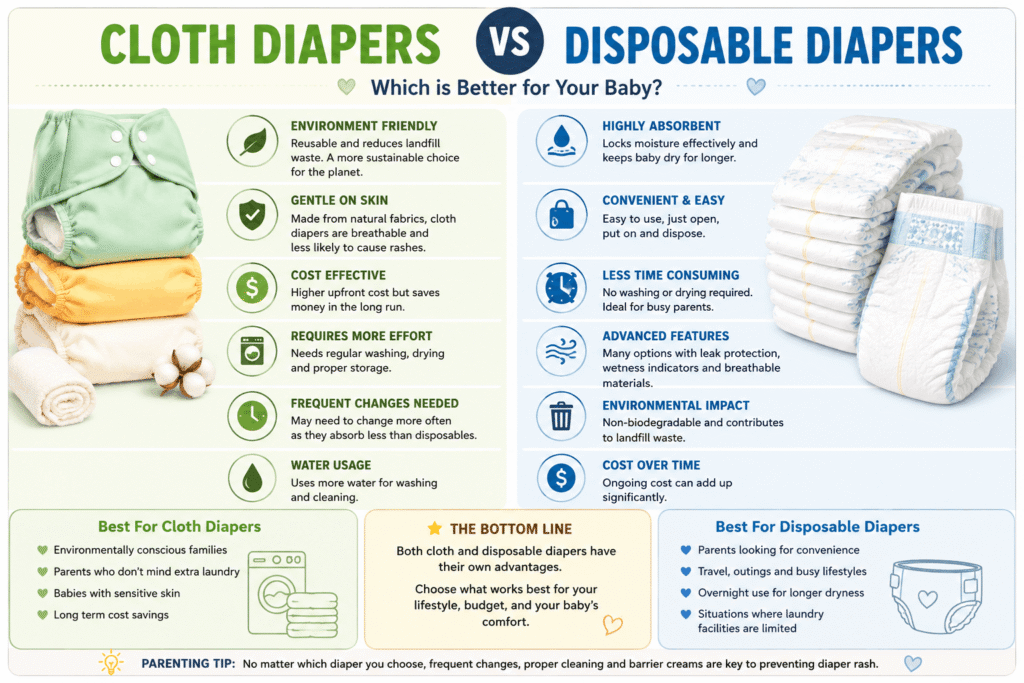
One of the most common questions parents ask is:
“Which diapers are better for preventing diaper rash?”
The answer isn’t as simple as cloth versus disposable.
Both options can keep babies comfortable when used correctly.
| Feature | Cloth Diapers | Disposable Diapers |
|---|---|---|
| Moisture Absorption | Moderate | Excellent |
| Breathability | Excellent | Good |
| Convenience | Lower | High |
| Environmental Impact | Better | Lower |
| Initial Cost | Higher | Lower upfront |
| Long-Term Cost | Lower | Higher |
| Rash Prevention | Good with frequent changes | Excellent due to absorbent layers |
Disposable Diapers
Modern disposable diapers are designed to:
- Pull moisture away from the skin.
- Keep babies drier for longer.
- Reduce prolonged exposure to urine.
This makes them particularly helpful for diaper rash prevention at night.
Cloth Diapers
Cloth diapers can also work well if:
- Changed immediately after becoming wet.
- Washed correctly.
- Free from detergent residue.
- Completely dry before reuse.
Parents who use cloth diapers often find success by increasing diaper-free time and changing diapers more frequently.
Ultimately, the best diaper is the one that keeps your baby’s skin clean, dry, and comfortable.
Common Mistakes Parents Make
Even experienced parents sometimes unknowingly increase the risk of diaper rash.
Avoid these common mistakes:
Waiting Too Long Between Diaper Changes
A wet diaper left on for several hours allows moisture and bacteria to irritate the skin.
Solution: Change diapers every 2–3 hours and immediately after bowel movements.
Rubbing the Skin Too Hard
Scrubbing during diaper changes can damage already irritated skin.
Solution: Always wipe gently and pat dry.
Fastening Diapers Too Tightly
Tight diapers increase:
- Friction
- Heat
- Moisture buildup
Choose a comfortable fit with room for airflow.
Skipping Barrier Cream
Many parents wait until a rash appears before using a diaper cream.
Barrier creams work best before irritation develops.
Think of them as prevention rather than treatment.
Using Scented Products
Fragrances, alcohol, and dyes found in some wipes or lotions may trigger irritation.
Stick with:
- Fragrance-free wipes
- Gentle cleansers
- Hypoallergenic skincare
Ignoring Early Redness
A tiny red patch can quickly become a painful rash if left untreated.
Early intervention is one of the simplest forms of diaper rash prevention.
Trying Too Many Home Remedies
Switching between multiple creams, oils, and homemade remedies can make it difficult to determine what’s helping—and may even worsen the irritation.
When in doubt:
- Keep the routine simple.
- Use gentle cleansing.
- Apply a trusted barrier cream.
- Monitor progress.
Frequently Asked Questions (FAQs)
1. How often should I change my baby’s diaper?
This is one of the most common questions new parents ask.
As a general rule:
- Newborns: Every 2–3 hours or whenever the diaper is wet or soiled (typically 8–12 changes per day).
- Older babies: Every 3–4 hours, plus immediately after every bowel movement.
Frequent diaper changes are one of the most effective ways to prevent diaper rash naturally.
2. Can teething cause diaper rash?
Teething itself does not directly cause diaper rash.
However, some babies drool more, experience mild digestive changes, or have more frequent bowel movements during teething. These changes may increase moisture around the diaper area and make irritation more likely.
Maintaining good baby diaper care during this time usually prevents problems.
3. How long does diaper rash take to heal?
Most mild diaper rashes begin improving within 24 to 48 hours and usually heal completely within 2 to 3 days with:
- Frequent diaper changes
- Barrier cream
- Gentle cleaning
- Diaper-free time
If the rash does not improve after several days or appears to worsen, consult your pediatrician.
4. Which diaper rash cream is best?
There isn’t one perfect cream for every baby.
Look for creams containing:
- Zinc oxide
- Petroleum jelly
- Panthenol
- Lanolin
For babies with recurring irritation, applying a diaper rash cream with zinc oxide during every diaper change can provide excellent protection.
You can also explore our recommended Amazon diaper rash creams earlier in this guide to compare features, ingredients, and pricing before making a purchase.
5. Can breastfed babies get diaper rash?
Yes.
Although breastfed babies may have different bowel habits than formula-fed babies, they can still develop diaper rash due to:
- Moisture
- Friction
- Sensitive skin
- Diarrhea
- Yeast infections
Good diaper hygiene remains the best prevention strategy regardless of feeding method.
6. Is diaper rash contagious?
A simple diaper rash caused by irritation is not contagious.
However, if the rash is caused by a fungal or bacterial infection, medical treatment may be necessary to prevent it from worsening.
7. Should babies sleep without diapers?
While diaper-free time during the day is beneficial, leaving babies without diapers overnight is usually impractical.
Instead:
- Use an absorbent overnight diaper.
- Apply a thick layer of barrier cream before bedtime.
- Change the diaper promptly in the morning.
This routine provides excellent diaper rash prevention at night.
8. Can cloth diapers cause diaper rash?
Cloth diapers themselves don’t cause diaper rash.
Problems usually occur when:
- Diapers aren’t changed frequently.
- Moisture remains against the skin.
- Detergent residue irritates sensitive skin.
With proper washing and frequent diaper changes, cloth diapers can work just as well as disposable diapers.
9. What are the signs of a yeast diaper rash?
A yeast diaper rash often appears:
- Bright red
- Shiny
- Inside skin folds
- Surrounded by small red bumps (“satellite lesions”)
Unlike regular diaper rash, it usually doesn’t improve with standard barrier creams alone and may require an antifungal cream prescribed by a healthcare professional.
10. When should I call my pediatrician?
Seek medical advice if:
- The rash lasts longer than 3 days.
- Your baby develops a fever.
- You notice blisters, pus, or bleeding.
- The rash spreads beyond the diaper area.
- Home treatment isn’t helping.
Early treatment can prevent complications and help your baby recover more comfortably.
Quick Daily Diaper Rash Prevention Routine
Consistency is the key to healthy baby skin. Follow this simple routine every day to reduce the risk of diaper rash.
| Time | What to Do |
|---|---|
| Morning | Change diaper, gently clean the area, pat dry, and apply a barrier cream before putting on a fresh diaper. |
| Throughout the Day | Check diapers every 2–3 hours. Change immediately after bowel movements. Give your baby 10–15 minutes of diaper-free time if possible. |
| Afternoon | Inspect the diaper area for early signs of redness or irritation. Reapply a protective cream if needed. |
| Evening | During bath time, clean the diaper area with lukewarm water and avoid harsh soaps. Allow the skin to dry completely before bedtime. |
| Night | Use a highly absorbent overnight diaper and apply a thick layer of diaper rash cream to protect the skin while your baby sleeps. |
Following this simple routine can dramatically reduce the chances of developing baby diaper rash.
Final Thoughts
Diaper rash is one of the most common concerns parents face during the first few years of their baby’s life—but the good news is that most cases are completely preventable.
By understanding the common diaper rash causes, recognizing the early symptoms, and following a consistent diaper-changing routine, you can greatly reduce the chances of your little one developing painful skin irritation.
Remember, prevention is always easier than treatment. Frequent diaper changes, gentle cleansing, allowing the skin to dry completely, and using a quality diaper rash cream can go a long way in protecting your baby’s delicate skin.
If a rash does appear, don’t panic. Most mild diaper rashes heal quickly with proper care at home. However, persistent, severe, or infected rashes should always be evaluated by your pediatrician.
At ParentingFinds, our goal is to help parents make informed, confident decisions with practical, evidence-based guidance. Every baby is different, so don’t hesitate to consult your healthcare provider if you’re ever unsure about your child’s skin health.