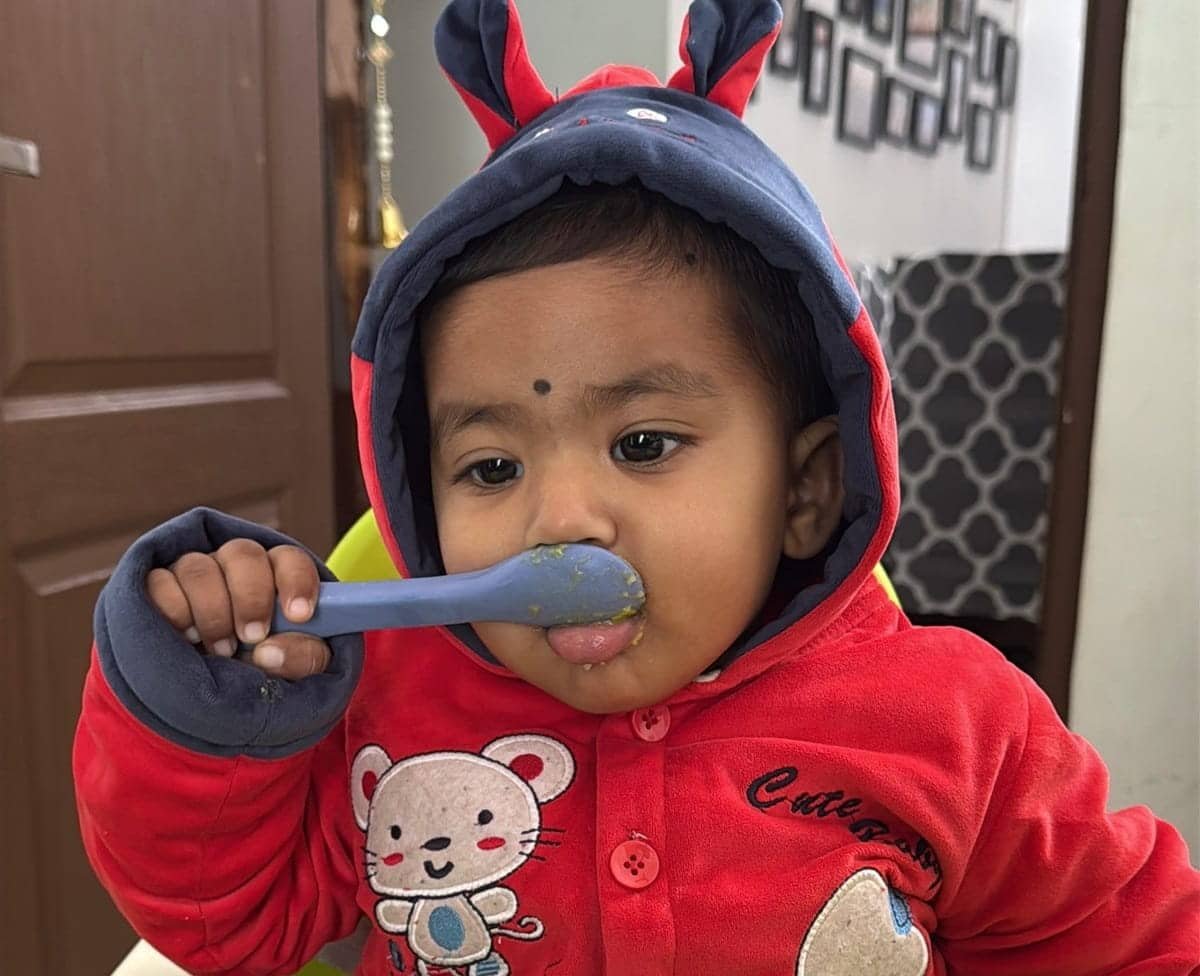


Yes, most babies can begin exploring appropriately prepared finger foods for 8 month old babies by around this age, provided they show signs of readiness. Finger foods should be soft, easy to grasp, and prepared in a size and shape that reduces choking risk. At 8 months, finger foods complement breast milk or infant formula rather than automatically replacing milk feeds. Every baby develops differently, so readiness matters more than age alone.
The World Health Organization (WHO) recommends complementary foods from around 6 months and notes that most babies can eat finger foods by 8 months.
Finger foods can support self-feeding, hand-eye coordination, fine motor skills, and exposure to different food textures. They can be offered alongside mashed foods and spoon-feeding, so you do not have to choose between traditional feeding and baby-led weaning.
The most important rule is simple: soft + appropriately sized + easy to grasp. Food should be tender enough to mash easily and prepared according to your baby’s developmental abilities.
Is an 8-Month-Old Ready for Finger Foods?
Many 8-month-old babies are ready for 8 month old finger foods, but readiness signs are more important than the number of months on the calendar.
Signs Your Baby Is Ready
Your baby may be ready to explore finger foods if they can:
- Sit upright with good head and neck control
- Bring objects toward their mouth
- Show interest in food
- Reach for and grasp objects
- Coordinate their hands, eyes, and mouth
- Swallow food rather than repeatedly pushing it out
- Begin moving food around their mouth
CDC guidance identifies skills such as head and neck control, bringing objects to the mouth, and grasping objects as important developmental abilities associated with beginning complementary foods.
If your baby was born prematurely or has difficulty swallowing, sitting, or managing food textures, speak with your pediatrician or another qualified healthcare professional about individual readiness.
What If My 8-Month-Old Doesn’t Want Finger Foods?
Don’t force it.
Some babies immediately grab food and put it into their mouths, while others need more time to explore unfamiliar textures. Offer appropriately prepared soft finger foods for babies regularly and let your baby touch, smell, squish, and taste food at their own pace.
You can also combine self-feeding with familiar mashed foods or spoon-fed foods. Keeping mealtimes relaxed can help your baby become more comfortable with 8 month old eating.
What Makes a Good Finger Food for an 8-Month-Old?
The best finger foods for 8 month old babies are not simply foods that are small. They need to have the right texture, shape, size, and nutritional value.
Texture
For an 8-month-old, food should generally be:
- Soft
- Cooked until tender when necessary
- Easy to mash between your fingers
- Soft enough for your baby to manage with their gums
- Free from hard pieces, bones, pits, or tough skins
Texture matters just as much as size. A small piece of hard food can still present a choking hazard.
Shape and Size
When babies are developing their palmar grasp, longer pieces can be easier to hold than tiny cubes.
Finger-sized pieces can give a younger baby something to grasp in their fist, with part of the food extending beyond the hand. As your baby’s grasp develops, you can gradually move toward smaller, more manageable pieces.
NHS guidance similarly describes finger foods as pieces large enough for a baby to hold, with some food sticking out of the fist.
If you’re wondering how big should finger food be for an 8 month old, think about your baby’s current grasp and ability rather than following one rigid measurement. Food should be easy to hold and soft enough to mash.
Nutritional Value
The best finger foods for 8 month old babies should provide variety rather than focusing on one food group.
Try offering a combination of:
- Vegetables
- Fruits
- Whole grains and other grains
- Protein
- Dairy
- Healthy fats
- Iron-rich foods
Nutrient-dense foods are particularly valuable during complementary feeding because babies are gradually expanding their diet beyond breast milk or infant formula.
30+ Best Finger Foods for 8-Month-Old Babies
If you’re looking for what finger foods can I give my 8 month old, start with foods that are soft, appropriately prepared, and easy for your baby to grasp.
Here are more than 30 baby finger foods to try.
Soft Fruits
Fruit can be an easy starting point for fruit finger foods for 8 month old babies because many ripe fruits naturally have a soft texture.
- Banana – Cut into thick lengthwise strips or manageable pieces.
- Avocado – Offer thick wedges that are easy to grasp.
- Ripe pear – Use very ripe, soft pear or cook it until tender.
- Soft peach – Remove the pit and offer soft slices.
- Soft melon – Choose ripe melon and remove seeds and tough skin.
- Mango – Offer thick, soft slices of ripe mango.
- Papaya – Remove seeds and skin and cut into soft pieces.
- Cooked apple – Cook until it becomes soft enough to mash.
- Cooked pear – A useful option when fresh pear is still too firm.
Avoid offering hard chunks of raw fruit. Preparation should always make the food soft and manageable.
Soft Cooked Vegetables
Vegetables are excellent healthy finger foods for babies, particularly when cooked until very tender.
- Sweet potato – Cook until soft and cut into sticks.
- Potato – Serve soft pieces or sticks.
- Broccoli – Steam or cook until tender; the stem can provide a convenient handle.
- Cauliflower – Cook until soft enough to mash easily.
- Carrot – Cook until very soft rather than offering raw carrot.
- Pumpkin – Offer soft sticks or manageable pieces.
- Zucchini – Cook until tender and cut into easy-to-hold pieces.
- Butternut squash – Roast or steam until soft.
- Peas – Prepare appropriately rather than giving hard whole pieces.
WHO specifically advises avoiding choking-risk forms such as whole grapes and raw carrots.
Protein-Rich Finger Foods
Protein-rich foods can help make meals more nutrient-dense and give your baby opportunities to explore different textures.
- Omelet strips – Cook the egg thoroughly and cut into strips.
- Hard-boiled egg – Cook thoroughly and offer manageable pieces.
- Soft shredded chicken – Make sure there are no bones or tough pieces.
- Soft fish without bones – Cook thoroughly and carefully check for bones.
- Soft lentil patties – Make them soft enough to break apart easily.
- Soft bean patties – Use thoroughly cooked beans and a soft texture.
- Paneer strips – Offer soft, manageable strips.
- Plain full-fat yogurt – Serve in an age-appropriate way, such as from a spoon or preloaded spoon.
WHO’s complementary-feeding guidance emphasizes dietary diversity and nutrient-dense foods, including animal-source foods, fruits and vegetables, and pulses, nuts, and seeds in safe forms.
Grain and Starchy Finger Foods
These foods can provide energy and also introduce familiar family foods in baby-friendly textures.
- Soft toast strips
- Chapati strips
- Soft dosa strips
- Idli pieces
- Soft pasta
- Soft noodles
- Soft rice balls
- Soft poha
- Soft upma
These options are particularly useful when you’re looking for easy finger foods for 8 month old babies and want to adapt foods already prepared at home.
Indian Finger Foods for 8-Month-Old Babies
For Indian families, many familiar foods can become excellent Indian finger foods for 8 month old baby meals with a few simple modifications.
Easy Indian Finger Food Ideas
Try:
- Idli strips
- Dosa strips
- Soft chapati pieces
- Soft poha
- Soft vegetable upma
- Soft rice balls
- Sweet potato
- Paneer strips
- Soft dal-based patties
- Vegetable cheela strips
- Soft homemade millet preparations
These can make homemade finger foods for 8 month old babies easier to incorporate into everyday family meals.
How to Make Indian Baby Foods Baby-Friendly
When preparing Indian foods for an 8-month-old:
- Keep food soft and tender.
- Avoid added salt and sugar.
- Avoid whole nuts.
- Avoid spicy preparations.
- Modify family foods before adding salt or chilli-heavy ingredients.
- Focus on nutrient density.
- Remove hard, chewy, or difficult-to-manage pieces.
NHS guidance states that babies do not need added salt or sugar in their food.
A useful approach is to prepare a baby-friendly portion before adding salt, chilli, or other ingredients intended for older family members.
Finger Foods for an 8-Month-Old Without Teeth
One of the most common questions parents have is whether babies need teeth before they can eat finger foods.
The answer is no. Finger foods for 8 month old without teeth can include appropriately prepared soft foods because babies can use their gums to mash and manage suitably soft textures.
The key is not whether your baby has teeth; it is whether the food is soft enough and prepared safely.
Best No-Teeth Finger Foods
Some good options include:
- Banana
- Avocado
- Soft sweet potato
- Soft-cooked broccoli
- Soft idli
- Soft dosa
- Omelet strips
- Soft pasta
- Ripe mango
- Soft paneer
These are also useful finger foods for baby with no teeth, provided they are prepared to an appropriate texture.
Avoid hard, crunchy, round, or tough foods. When in doubt, test whether the food can be easily mashed between your fingers.
How to Cut Finger Foods for an 8-Month-Old
Knowing how to cut finger foods for 8 month old babies can make mealtimes much easier.
The right shape depends on the food and your baby’s developmental abilities. Texture should always be considered alongside size.
| Food | Suggested Preparation |
|---|---|
| Banana | Thick lengthwise strips |
| Avocado | Thick wedges |
| Sweet potato | Soft sticks |
| Broccoli | Soft florets with stem |
| Toast | Finger-length strips |
| Omelet | Thin strips |
| Idli | Soft strips or manageable pieces |
| Pasta | Soft, appropriately sized pieces |
| Mango | Thick soft slices |
| Paneer | Soft strips |
For babies who are still using a palmar grasp, longer pieces may be easier to pick up. As your baby’s pincer grasp develops, you can gradually adapt the shape and size.
There is no single perfect size for every 8-month-old. Always adapt food preparation to your baby’s developmental ability.
How Many Finger Foods Should an 8-Month-Old Eat?
There is no single universal portion size for an 8-month-old.
Start with small amounts and allow your baby to show you when they are hungry or full. Gradually increase the variety and amount of food as your baby becomes more comfortable with complementary feeding.
At 6–8 months, WHO guidance indicates that complementary foods are generally offered 2–3 times per day alongside milk feeds, with amounts gradually increasing according to appetite.
Finger foods are part of complementary feeding and do not necessarily replace breast milk or infant formula at this age.
Responsive feeding is more useful than forcing a particular number of bites or spoonfuls.
8-Month-Old Finger Food Meal Ideas
If you’re looking for practical 8 month old baby food ideas, combine foods from different groups rather than serving one food repeatedly.
Breakfast
Try:
- Idli + avocado
- Soft banana + omelet strips
- Soft dosa + yogurt
- Poha + soft fruit
These combinations provide opportunities to include carbohydrates, fruit or vegetables, and protein or healthy fats.
Lunch
Try:
- Soft rice + dal + vegetables
- Chapati strips + paneer
- Sweet potato + egg
- Soft vegetable pasta
Dinner
Try:
- Soft khichdi + vegetables
- Idli + vegetable mash
- Rice balls + dal
- Soft dosa + yogurt
Sample One-Day Feeding Pattern
A flexible day might look like:
- Morning milk feed
- Breakfast
- Milk feed
- Lunch
- Milk feed
- Dinner
- Additional milk feeds based on your baby’s needs
This is an example rather than a rigid feeding schedule. Babies differ in appetite, sleep patterns, milk intake, and readiness for solids.
Iron-Rich Finger Foods for 8-Month-Old Babies
Iron becomes particularly important during complementary feeding, making iron rich finger foods for 8 month old babies an important part of meal planning.
Good options include:
- Egg
- Meat
- Fish
- Lentils
- Beans
- Iron-fortified infant cereals
- Other appropriately prepared iron-rich foods
Try to include an iron-rich or protein-rich food regularly rather than relying primarily on fruit and vegetables.
WHO emphasizes dietary diversity and includes animal-source foods, fruits and vegetables, and pulses, nuts, and seeds in safe forms among important components of complementary diets.
Finger Foods and Baby-Led Weaning at 8 Months
Baby led weaning finger foods 8 months can be part of a baby’s meals when foods are appropriately prepared and the baby is developmentally ready.
Baby-led weaning generally means offering finger foods from the beginning rather than relying primarily on purées or spoon-fed foods. Traditional spoon-feeding and baby-led weaning do not have to be treated as opposing choices.
You can use a combination approach.
For example, your baby might:
- Pick up a soft broccoli floret independently.
- Eat soft idli with their hands.
- Explore a banana strip.
- Eat mashed lentils from a spoon.
- Try yogurt from a preloaded spoon.
This means 8 month old baby led weaning foods can coexist with spoon-fed and mashed foods.
NHS guidance describes baby-led weaning as offering finger foods rather than relying on purées, while combination feeding approaches are also possible.
How to Introduce New Finger Foods Safely
Introducing new foods can be exciting, but safety should come first.
Start With One Food or Combination?
You can offer familiar foods alongside a new food. For foods that may cause an allergic reaction, introducing them in an appropriate form and paying attention to your baby’s response can make it easier to identify a potential problem.
Introduce Common Allergens
Common allergenic foods include:
- Egg
- Peanut in an appropriate smooth form
- Dairy
- Wheat/gluten
- Fish
Allergenic foods should be offered in safe forms that are suitable for your baby’s developmental stage.
NHS guidance advises introducing foods containing allergens such as peanuts, eggs, gluten, and fish from around 6 months, one at a time and in small amounts, so potential reactions can be identified.
If your baby develops symptoms of an allergic reaction, stop offering the suspected food and seek appropriate medical advice.
Choking Hazards for 8-Month-Old Babies
Food safety is one of the most important parts of introducing safe finger foods for babies.
Parents should understand the difference between gagging and choking and learn how to prepare food to reduce choking risks.
Gagging vs. Choking
Gagging is a normal protective response that can happen as babies learn to manage new textures. A gagging baby may cough, make sounds, or bring food forward.
Choking occurs when the airway becomes blocked. It is an emergency and requires immediate action.
Because choking can be serious, caregivers should learn infant choking first aid from a qualified source rather than relying solely on an online description.
Foods That Can Be Choking Hazards
Avoid or modify common choking hazards, including:
- Whole grapes
- Whole nuts
- Raw carrot
- Raw apple chunks
- Hard chunks of food
- Whole cherry tomatoes
- Popcorn
- Sticky spoonfuls of nut butter
- Hard candies
- Sausage or hot-dog rounds
- Large chunks of meat or cheese
WHO and NHS guidance specifically highlights choking risks associated with hard foods and foods such as whole grapes, whole nuts, and raw carrots.
Safe Feeding Environment
Always:
- Have your baby sit upright while eating.
- Stay with your baby during meals.
- Avoid feeding while your baby is lying down, crawling, or walking.
- Don’t rush your baby.
- Prepare food according to your baby’s developmental ability.
Supervision is essential even when you’re serving foods that seem soft or familiar.
Foods to Avoid or Limit at 8 Months
Some foods are inappropriate or need modification for babies.
Avoid or limit:
- Added salt
- Added sugar
- Honey before 12 months
- Whole nuts
- Hard raw vegetables
- Unpasteurized foods
- Foods with choking-risk shapes
- Sugary drinks
- Highly processed foods
- Excessively salty foods
- Whole grapes
- Undercooked eggs or meat where food safety is a concern
WHO recommends avoiding foods high in sugar, salt, and trans fats and avoiding sugar-sweetened beverages.
Honey should not be given before 12 months because of the risk of infant botulism.
The goal isn’t to make your baby’s diet complicated. Instead, focus on simple, minimally processed foods with appropriate textures.
How to Make Finger Foods More Nutritious
One easy way to build balanced meals is to think of a simple 3-part baby plate.
1. Iron or Protein Food
Examples include:
- Egg
- Lentils
- Beans
- Meat
- Fish
- Paneer
2. Fruit or Vegetable
Examples include:
- Banana
- Avocado
- Broccoli
- Sweet potato
- Pumpkin
3. Energy-Rich Food
Examples include:
- Rice
- Potato
- Oats
- Whole grains
- Chapati
You can also include healthy fats where appropriate.
This approach makes it easier to create healthy finger foods for 8 month old babies without obsessing over individual nutrients at every meal.
For example, soft rice with dal and vegetables can provide energy, protein, iron, and vegetables in one meal. Likewise, an omelet strip with avocado and soft toast can combine protein, healthy fats, and an energy-rich food.
Common Mistakes Parents Make With Finger Foods
Even with good intentions, parents can make introducing self feeding baby foods more complicated than it needs to be.
Common mistakes include:
- Giving foods that are too hard
- Cutting food into unsafe shapes
- Offering too many foods at once
- Pressuring the baby to eat
- Comparing your baby’s intake with another baby’s
- Avoiding textures for too long
- Relying only on fruit
- Forgetting iron-rich foods
- Adding unnecessary salt or sugar
- Treating milk feeds as suddenly unnecessary
Responsive feeding means paying attention to your baby’s hunger and fullness cues and encouraging eating without forcing.
WHO recommends responsive feeding, including recognizing hunger and fullness cues and encouraging babies without forcing them.
Remember that one meal may be tiny while another may be much more successful. Looking at your baby’s overall eating pattern is generally more useful than judging a single meal.
Frequently Asked Questions About Finger Foods for 8-Month-Olds
Can an 8-month-old eat finger foods?
Yes. Most babies can begin eating appropriately prepared finger foods around 8 months when they are developmentally ready. Foods should be soft, easy to grasp, and prepared in a shape and size appropriate for the baby. Finger foods can be offered alongside mashed foods, spoon-feeding, breast milk, or infant formula.
What are the best finger foods for an 8-month-old?
Some of the best finger foods for 8 month old babies include banana, avocado, sweet potato, broccoli, soft carrot, omelet strips, soft chicken, paneer, idli, dosa, soft pasta, and ripe mango. Choose foods from different food groups and prioritize soft textures.
Can an 8-month-old eat finger foods without teeth?
Yes. Finger foods for 8 month old without teeth can include appropriately prepared banana, avocado, sweet potato, broccoli, idli, dosa, omelet, pasta, mango, and paneer. Babies can use their gums to manage suitably soft foods, so teeth are not required for every finger food.
How big should finger foods be for an 8-month-old?
There is no one-size-fits-all measurement. Longer, finger-sized pieces can be easier for babies who are still using a palmar grasp. The food should be soft enough to mash easily and large enough to grasp safely. As your baby’s pincer grasp develops, you can adapt the size and shape.
What finger foods can I give my 8-month-old?
You can try soft banana, avocado, ripe mango, cooked sweet potato, broccoli, cauliflower, soft carrot, omelet strips, shredded chicken, paneer, soft toast, idli, dosa, chapati strips, pasta, poha, and upma.
Can an 8-month-old eat banana as finger food?
Yes. Banana is a convenient first finger food for baby because ripe banana is naturally soft. Cut it into thick lengthwise strips that your baby can grasp. Choose a ripe banana rather than one that is firm and difficult to mash.
Can an 8-month-old eat toast?
Yes, appropriately prepared toast can be offered as finger food. Cut it into manageable strips and avoid hard, overly crisp pieces. The texture should be suitable for your baby’s developmental ability.
Can an 8-month-old eat rice?
Yes. Rice can be included as part of solid foods for 8 month old babies when prepared into a soft, manageable texture. Soft rice balls, soft rice mixed with dal, or other appropriately prepared rice dishes can be easier to manage than loose, dry grains.
What Indian finger foods can I give my 8-month-old?
Good Indian finger foods for 8 month old baby options include soft idli, dosa strips, chapati pieces, poha, vegetable upma, soft rice balls, sweet potato, paneer strips, dal-based patties, vegetable cheela strips, and soft homemade millet preparations.
How many times a day should an 8-month-old eat solids?
At 6–8 months, WHO guidance indicates that complementary foods are generally offered around 2–3 times per day, alongside milk feeds, with the amount gradually increasing according to appetite. Your baby’s individual feeding pattern can vary, so avoid treating this as a rigid schedule.
Is baby-led weaning safe at 8 months?
Baby-led weaning can be an option for an appropriately developing baby when foods are prepared safely and the baby is supervised. You do not have to choose between baby-led weaning and spoon-feeding. A combination approach can allow your baby to explore baby led weaning finger foods 8 months while also eating mashed or spoon-fed foods.
What foods should an 8-month-old avoid?
Avoid foods that are hard, difficult to chew, or presented in choking-risk shapes. Examples include whole nuts, whole grapes, raw carrot, hard raw foods, popcorn, hard candies, sticky spoonfuls of nut butter, and large chunks of meat or cheese. Also avoid honey before 12 months and limit added salt, added sugar, and sugary drinks.
Final Takeaway
Introducing finger foods for 8 month old babies can be a fun way to encourage self-feeding while expanding your baby’s exposure to different flavors, textures, and nutrient-dense foods.
Start with soft, easy-to-grip foods and gradually introduce more variety. Include iron- and protein-rich foods alongside fruits, vegetables, grains, and healthy fats. Let your baby explore food without pressure and progress textures according to their abilities.
Most importantly, always supervise your baby while eating, prepare food carefully, and avoid known choking hazards. Breast milk or infant formula can continue alongside complementary foods according to your baby’s needs.
The goal isn’t a perfect plate at every meal. It’s about giving your baby safe opportunities to explore baby self feeding foods, develop feeding skills, and gradually become a confident eater.