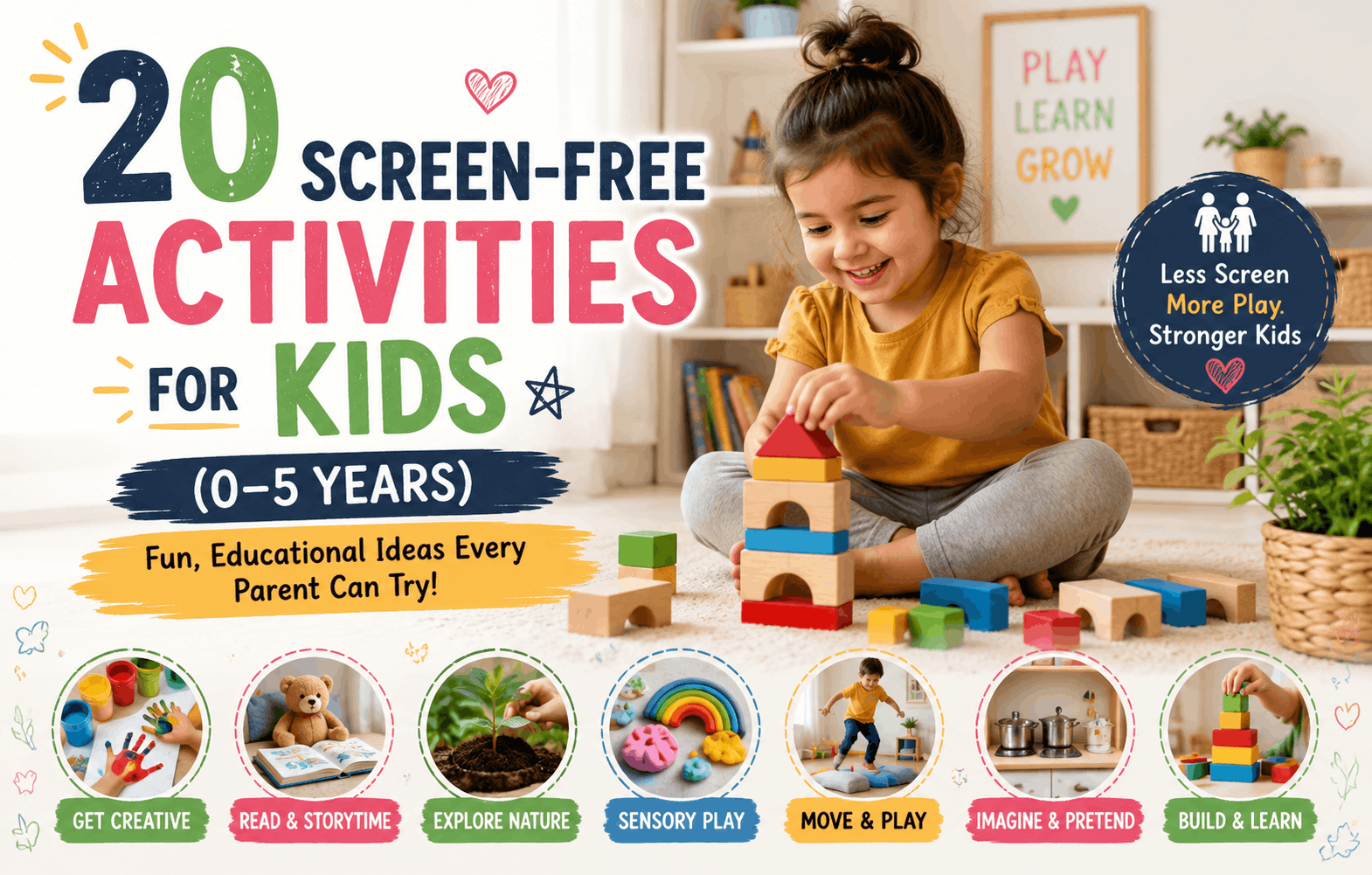

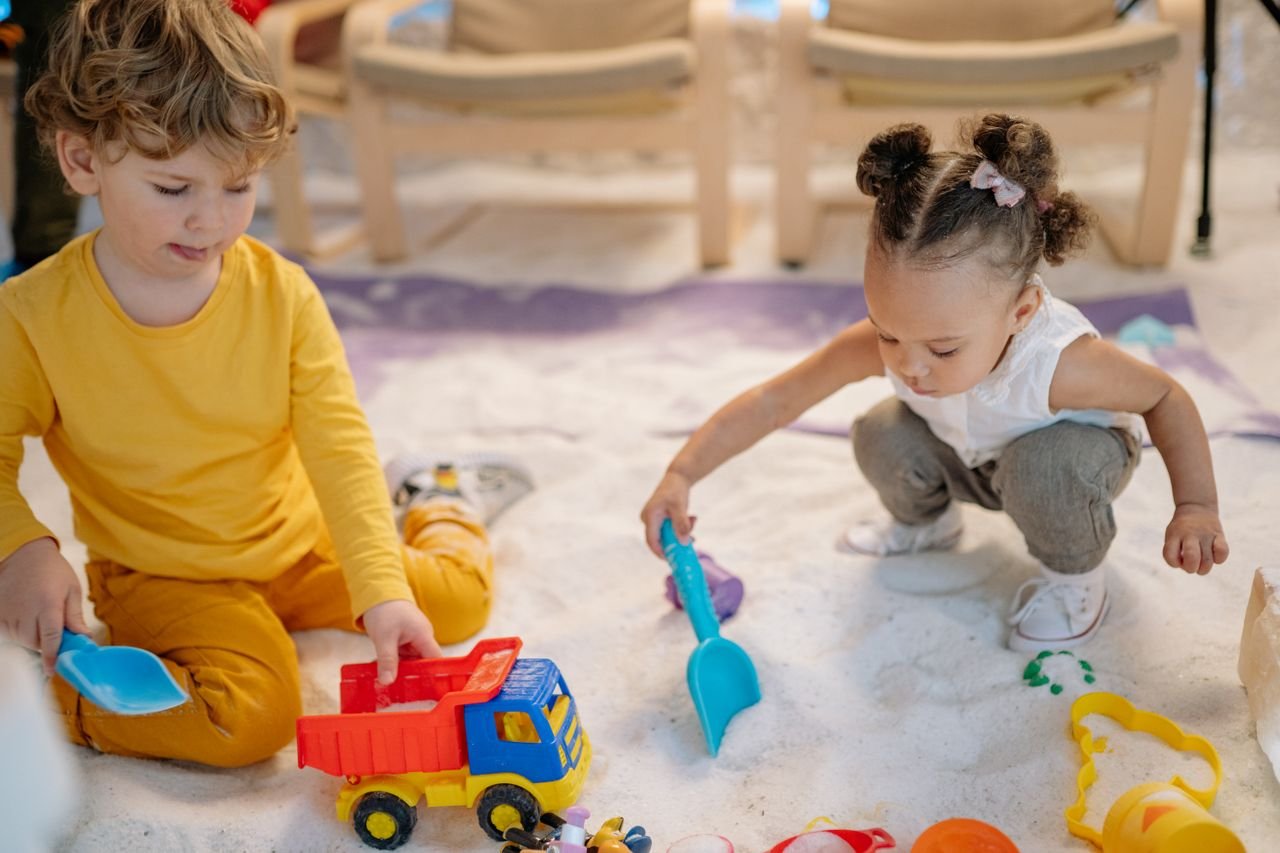
Keeping a toddler entertained can sometimes feel like a full-time job. One minute they are happily playing, and the next they are climbing onto the sofa, emptying a cupboard, or asking, “What can we do?”
The good news is that you don’t need expensive toys, complicated crafts, or hours of preparation to keep your little one engaged. Some of the best activities for toddlers use things you already have at home.
From simple sensory activities and toddler crafts to outdoor adventures, pretend play, learning games, and screen-free activities, these 50 fun and easy activities for toddlers are designed to give parents plenty of ideas for everyday play.
The activities below can be adapted according to your toddler’s age, interests, abilities, and attention span. More importantly, the goal isn’t to create a perfect activity or a perfect finished product. It is to give your child opportunities to explore, move, communicate, experiment, imagine, and spend meaningful time with you.
Why Are Activities and Play Important for Toddlers?
Play is one of the main ways young children explore their surroundings and practice new skills. UNICEF describes play as an opportunity for children to explore their environment, practice developing skills, and bond with caregivers.
That means everyday toddler activities can be much more than a way to keep your child busy.
Fine Motor Skills
Activities such as stacking blocks, turning pages, placing stickers, drawing, sorting objects, and transferring items can give toddlers opportunities to practice using their hands and fingers.
Gross Motor Skills
Running, walking, dancing, kicking a ball, jumping, balancing, and simple obstacle courses encourage movement and coordination.
Language and Communication
Reading books, singing songs, naming objects, describing what your child is doing, and playing simple guessing games can create natural opportunities for language practice.
Cognitive and Problem-Solving Skills
Sorting, matching, puzzles, building, hiding and finding objects, and experimenting with cause and effect encourage toddlers to think and explore.
Social and Emotional Skills
Pretend play, taking turns, following simple directions, helping around the house, and playing together can support opportunities to practice communication, independence, cooperation, and emotional expression.
The CDC recommends activities such as reading, matching games, exploring, pretend play, songs, and simple movement games as ways parents can engage with toddlers.
50 Fun and Easy Activities for Toddlers
Here are 50 simple toddler activities you can try at home or outdoors. Most require little preparation, and many use everyday household items.
Easy Indoor Activities for Toddlers
1. Build a Block Tower
Give your toddler large blocks or other age-appropriate stacking toys and invite them to build a tower.
Count the blocks as you stack them together. Once the tower is ready, let your toddler knock it down and start again.
Skills supported: Fine motor coordination, hand-eye coordination, problem-solving, and early counting.
Parent tip: Don’t worry about how tall the tower becomes. The building and experimenting are the important parts.
2. Color Sorting Game
Collect several large, safe household objects or toys in different colors. Ask your toddler to place objects into groups based on their colors.
You can say, “Can you find something red?” or “Let’s put all the blue things together.”
Skills supported: Color recognition, categorization, observation, and language.
3. Shape Hunt
Go around your home looking for simple shapes.
Find a round plate, a rectangular book, a square cushion, or another familiar object.
Talk about the shapes as you find them.
Skills supported: Observation, vocabulary, early math concepts, and categorization.
4. Simple Puzzle Time
Choose an age-appropriate puzzle with large pieces and simple pictures.
Start by naming the animals, colors, or objects shown on the pieces. Let your toddler try to place each piece independently before offering help.
Skills supported: Problem-solving, visual-spatial awareness, fine motor skills, and concentration.
Simple puzzles and matching games are among the activities recommended by the CDC for toddlers.
5. Sticker Art
Give your toddler large, age-appropriate stickers and a sheet of paper.
Let them place stickers wherever they want. You can also make a simple theme such as “animals,” “flowers,” or “colors.”
Skills supported: Fine motor skills, hand-eye coordination, creativity, and decision-making.
6. Laundry Sorting Helper
Turn a normal household task into one of the easiest activities for toddlers at home.
Give your toddler a small pile of clean, safe clothes and ask them to match socks or separate clothes by type or color.
Skills supported: Matching, categorization, independence, and practical life skills.
7. Toy Treasure Hunt
Hide a few familiar toys in easy-to-find places around a safe room.
Give simple clues such as, “Can you find your teddy?” or “Where is the red ball?”
Skills supported: Memory, observation, language, problem-solving, and object recognition.
8. Paper Tearing Collage
Give your toddler pieces of paper that can be safely torn and a large sheet of paper.
Let them tear the paper into pieces and arrange them into a collage with your help.
Skills supported: Hand strength, fine motor coordination, creativity, and sensory exploration.
Always supervise craft activities and use materials that are appropriate for your child’s age.
9. Indoor Obstacle Course
Create a simple obstacle course using cushions, soft play equipment, or clear pathways.
Your toddler can walk around cushions, crawl through a safe tunnel, step over a low obstacle, or follow a simple path.
Skills supported: Gross motor skills, balance, coordination, and following directions.
10. Follow-the-Leader
Stand in front of your toddler and perform simple movements such as clapping, marching, waving, turning around, or stomping.
Invite your toddler to copy you, then let them become the leader.
Skills supported: Listening, imitation, movement, coordination, and social interaction.
The CDC specifically suggests follow-the-leader and similar movement games for toddlers.
Sensory Activities for Toddlers
Sensory play gives toddlers opportunities to explore different textures, temperatures, sounds, movements, and materials.
11. Water Pouring Station
Fill a shallow container with a small amount of water and provide cups or containers for pouring and transferring.
Let your toddler scoop water from one container to another.
Skills supported: Hand-eye coordination, pouring, concentration, and sensory exploration.
Safety: Never leave a toddler alone around water. Stay within immediate reach and supervise continuously.
12. Texture Basket
Create a basket containing safe objects with different textures.
You might include a soft cloth, a smooth wooden object, a textured ball, or another age-appropriate item.
Use words such as “soft,” “smooth,” “bumpy,” and “rough.”
Skills supported: Sensory exploration, vocabulary, observation, and communication.
13. Edible Sensory Play
For toddlers who still explore objects with their mouths, you can consider using suitable food-based sensory materials.
Cooked pasta, soft food textures, or other age-appropriate foods can provide opportunities to touch, squeeze, scoop, and explore.
Skills supported: Sensory exploration, hand coordination, and descriptive language.
Always consider allergies, choking risks, food temperature, and your child’s developmental stage.
14. Ice Cube Exploration
Place a few large ice cubes in a suitable container and let your toddler observe how they feel and change.
Talk about words such as “cold,” “wet,” “hard,” and “melting.”
Skills supported: Sensory exploration, observation, vocabulary, and early science concepts.
15. Homemade Sensory Bag
Place suitable liquid or gel-like material inside a sturdy sealed sensory bag.
Tape the bag securely to a surface and allow your toddler to press, touch, and observe it.
Skills supported: Sensory exploration, hand strength, visual tracking, and curiosity.
Safety: Check the bag regularly for leaks or damage and supervise throughout the activity.
16. Dry Scooping and Transferring
Give your toddler cups and containers along with a suitable, large-sized sensory material.
Encourage them to scoop and transfer the material between containers.
Skills supported: Fine motor coordination, hand-eye coordination, concentration, and early problem-solving.
Avoid materials that present a choking risk.
17. Sponge Squeeze Game
Place a sponge in a small amount of water and encourage your toddler to squeeze it into another container.
Make it into a game by seeing how much water they can transfer.
Skills supported: Hand strength, coordination, concentration, and sensory exploration.
18. Nature Texture Tray
Collect safe, larger natural objects such as leaves or large pinecones and place them in a tray for supervised exploration.
Talk about how each object looks and feels.
Skills supported: Sensory awareness, observation, vocabulary, and curiosity.
Never use small objects that could be placed in the mouth, and supervise closely.
Creative and Craft Activities for Toddlers
Toddler crafts don’t have to look perfect. In fact, the process of experimenting with colors, textures, shapes, and materials is often more valuable than the final artwork.
19. Finger Painting
Give your toddler washable, child-appropriate paint and a large sheet of paper.
Let them experiment with dots, lines, swirls, and handprints.
Skills supported: Creativity, sensory exploration, hand coordination, and self-expression.
20. Sponge Painting
Cut or use large child-safe sponges to make simple prints with washable paint.
You can make circles, squares, flowers, or abstract patterns.
Skills supported: Creativity, coordination, pattern exploration, and sensory play.
21. Handprint Art
Create a simple handprint or footprint artwork using child-safe materials.
Turn it into an animal, flower, tree, or family keepsake.
Skills supported: Creativity, sensory awareness, and self-expression.
22. Nature Collage
During a walk, collect appropriate natural materials such as larger leaves or flowers where permitted.
Arrange them on paper to create a collage.
Skills supported: Creativity, observation, sensory exploration, and fine motor skills.
23. Crayon Scribble Art
Give your toddler large, age-appropriate crayons and paper.
Let them make lines, circles, dots, and scribbles without asking them to draw a specific picture.
Skills supported: Fine motor control, creativity, and early mark-making.
24. Paper Plate Animal
Use a paper plate to make a simple animal face.
Your toddler can help choose the eyes, ears, colors, and other features.
Skills supported: Creativity, language, decision-making, and fine motor skills.
25. Cotton Ball Art
Use cotton balls and child-safe glue with close supervision to create clouds, snow, flowers, or simple patterns.
Skills supported: Fine motor skills, creativity, and sensory exploration.
26. Sticker Collage
Give your toddler different large stickers and a sheet of paper.
Instead of telling them exactly where each sticker should go, allow them to create their own picture.
Skills supported: Fine motor control, creativity, decision-making, and independence.
27. Homemade Playdough
Use age-appropriate homemade or commercial playdough and let your toddler squeeze, roll, flatten, and shape it.
Skills supported: Hand strength, fine motor skills, creativity, and sensory exploration.
Always supervise playdough use and select materials appropriate for your child’s age.
28. Music and Movement Art
Play some music while your toddler draws, scribbles, or makes marks on paper.
Encourage them to move to the rhythm and then return to their artwork.
Skills supported: Creativity, movement, rhythm, coordination, and self-expression.
Learning Activities for Toddlers
Learning activities for toddlers don’t need to feel like lessons. Everyday games, conversations, songs, books, and household activities can provide natural learning opportunities.
29. Match the Socks
Place several clean socks on the floor and ask your toddler to find matching pairs.
For younger toddlers, begin with just two or three pairs.
Skills supported: Matching, visual discrimination, categorization, and problem-solving.
30. Count the Toys
Choose a few large toys and count them together.
“Let’s count your cars. One, two, three!”
You can also count blocks while building a tower.
Skills supported: Early numeracy, counting, language, and memory.
31. Find the Color
Ask your toddler to find an object of a particular color.
For example, “Can you find something yellow?”
Once they find it, repeat the color name together.
Skills supported: Color recognition, observation, vocabulary, and listening.
32. Body Parts Game
Ask simple questions such as:
“Where is your nose?”
“Where are your toes?”
“Can you touch your ears?”
You can make the game more fun by singing a body-parts song.
Skills supported: Vocabulary, listening, body awareness, and imitation.
33. Animal Sound Game
Show your toddler pictures of animals or use animal toys.
Ask, “What does a cow say?” or make the sound yourself and invite your toddler to copy you.
Skills supported: Language, memory, imitation, and communication.
34. Simple Sorting Game
Sort safe household objects according to one characteristic, such as color, shape, or size.
Keep the game simple and change the sorting rule as your toddler becomes more comfortable.
Skills supported: Categorization, observation, early math concepts, and problem-solving.
The CDC notes that toddlers around 2 years may begin sorting objects by shape and color, although children develop skills at different rates.
35. Storytime With Questions
Choose a picture book and read it together.
Point to familiar objects and ask simple questions:
“Where is the dog?”
“What color is the ball?”
“What is the baby doing?”
You can also simply describe the pictures without asking questions.
Skills supported: Language, listening, vocabulary, attention, and parent-child connection.
36. Sing Nursery Rhymes
Sing familiar nursery rhymes and add hand movements.
Songs such as body-part songs, action rhymes, and simple repetitive songs can make language practice playful.
Skills supported: Language, memory, listening, rhythm, and movement.
37. Letter or Picture Matching
For younger toddlers, start with matching identical pictures rather than expecting formal letter recognition.
Match two pictures of the same animal, vehicle, fruit, or familiar object.
Skills supported: Visual discrimination, matching, memory, and vocabulary.
38. “What Am I?” Object Game
Choose a familiar object and describe it using simple clues.
For example:
“I am round. You can kick me. What am I?”
Your toddler can guess the ball.
Skills supported: Listening, vocabulary, memory, and problem-solving.
Pretend Play Activities for Toddlers
Pretend play gives toddlers a chance to imitate everyday experiences and experiment with different roles.
39. Pretend Kitchen
Set up a small pretend kitchen using age-appropriate toys.
Your toddler can pretend to cook, serve food, wash dishes, or feed a stuffed animal.
Skills supported: Imagination, language, imitation, and social-emotional development.
40. Teddy Bear Doctor
Let your toddler pretend that a teddy bear or stuffed animal is visiting the doctor.
They can listen to its heartbeat with a toy stethoscope, give it a blanket, or pretend to check its temperature.
Skills supported: Pretend play, empathy, language, and emotional expression.
41. Baby Doll Care
If your toddler enjoys dolls, encourage them to pretend to feed, dress, bathe, or put the doll to sleep.
You can model gentle caregiving behaviors.
Skills supported: Imagination, communication, sequencing, and social-emotional learning.
42. Toy Grocery Store
Turn a small area into a pretend grocery shop.
Your toddler can choose toy food, place it in a basket, and pretend to pay.
Skills supported: Pretend play, vocabulary, counting, social interaction, and decision-making.
43. Make a Blanket Fort
Use blankets and cushions to create a simple, stable play space.
Read a book inside, bring stuffed animals, or pretend that it is a camping tent.
Skills supported: Imagination, language, spatial awareness, and social interaction.
Make sure the structure is safe and cannot collapse onto your child.
44. Pretend Phone Call
Give your toddler a safe toy phone or another suitable pretend-play object.
Pretend to call grandparents, a friend, a doctor, or a shop.
Encourage simple conversation.
Skills supported: Language, conversation, imitation, and social understanding.
Pretend play is an important type of play during the toddler years, and the CDC recommends encouraging children to engage in make-believe play.
Outdoor Activities for Toddlers
Outdoor play gives toddlers opportunities to move, explore, observe nature, and experience their surroundings.
45. Nature Walk
Take a slow walk around a safe outdoor area.
Point out leaves, trees, flowers, birds, vehicles, clouds, or sounds.
Ask your toddler what they notice.
Skills supported: Observation, vocabulary, movement, curiosity, and sensory exploration.
46. Ball Kicking Game
Use a soft, age-appropriate ball and kick it gently back and forth.
You can start by simply rolling the ball toward your toddler.
Skills supported: Gross motor skills, balance, coordination, and turn-taking.
47. Bubble Chase
Blow bubbles and let your toddler watch, reach for, pop, or chase them.
You can use words such as “big,” “small,” “up,” “down,” “fast,” and “slow.”
Skills supported: Gross motor movement, visual tracking, language, and coordination.
48. Sidewalk Chalk
On a suitable outdoor surface, draw circles, lines, roads, animals, or simple shapes using sidewalk chalk.
Let your toddler add their own marks.
Skills supported: Creativity, fine motor control, early shape concepts, and self-expression.
49. Mini Scavenger Hunt
Create a simple list of things your toddler can look for:
- A leaf
- Something yellow
- A flower
- A large stone
- A bird
- A stick
Keep the hunt simple and use safe objects.
Skills supported: Observation, vocabulary, memory, movement, and problem-solving.
50. Follow-the-Path Adventure
Create a simple path using safe outdoor landmarks.
Ask your toddler to walk to a tree, turn around, walk toward a bench, or follow a line.
Skills supported: Gross motor skills, listening, balance, spatial awareness, and following directions.
Toddler Activities by Age
Children develop at different rates, so age-based activity suggestions should be treated as general ideas rather than strict rules.
Activities for 1-Year-Old Toddlers
For activities for 1 year old toddlers, focus on simple exploration and interaction.
Try:
- Hide-and-find games
- Putting objects in and taking them out
- Stacking large blocks
- Simple songs
- Naming familiar objects
- Looking at picture books
- Water exploration with close supervision
- Walking games
- Simple imitation games
UNICEF includes hide-and-search, naming objects, walking together, and simple object play among activities for young children.
Activities for 18-Month-Old Toddlers
For activities for 18 month old toddlers, try:
- Sorting large safe objects
- Putting toys in and out of containers
- Pretend play
- Household helper activities
- Simple movement games
- Picture books
- Naming body parts
- Songs with actions
- Simple sensory play
At this age, your toddler may enjoy copying what adults do and experimenting with greater independence.
Activities for 2-Year-Old Toddlers
There are many possibilities for activities for 2 year olds, including:
- Simple puzzles
- Block towers
- Pretend cooking
- Drawing
- Finger painting
- Sorting games
- Ball games
- Nature walks
- Simple obstacle courses
- Household helping
- Nursery rhymes
The CDC recommends activities such as balls, blocks, simple puzzles, songs, walks, pretend play, and helping with everyday tasks for children around this age.
Activities for 3-Year-Old Toddlers
For older toddlers approaching preschool age, try:
- More elaborate pretend play
- Simple storytelling
- Matching games
- Craft projects
- Nature scavenger hunts
- Dance games
- Obstacle courses
- Counting games
- Simple sorting challenges
- Dress-up play
Children at this stage may enjoy taking a more active role in choosing and directing their play.
Best No-Prep Activities for Toddlers
Sometimes you need an activity right now—without gathering supplies or creating a complicated setup.
Try these no-prep toddler activities:
- Follow the leader
- Dance party
- Freeze dance
- Toy treasure hunt
- Storytime
- Animal sounds
- Color hunt
- Count the toys
- Pretend cooking
- Body-parts game
These are also useful when you’re looking for quick toddler activities, 5 minute toddler activities, or activities to keep toddlers busy while you finish a small household task.
Screen-Free Activities for Toddlers
If you’re looking for screen-free activities for toddlers, remember that screen-free time doesn’t have to mean structured learning every minute.
Try:
- Reading books
- Building blocks
- Pretend play
- Drawing
- Dancing
- Singing
- Puzzles
- Sensory play
- Outdoor walks
- Household helping
- Ball games
- Sorting
- Nature exploration
The CDC notes that toddlers learn through talking, playing, and interacting with other people, and recommends limiting screen exposure while encouraging active interaction and play.
The goal isn’t to make parents feel guilty about screens. Instead, screen-free activities can simply provide more opportunities for movement, conversation, exploration, and connection.
How to Choose the Right Activity for Your Toddler
You don’t have to follow a rigid activity schedule. Watch what your toddler needs in the moment.
If Your Toddler Is Full of Energy
Try:
- Dancing
- Ball games
- Obstacle courses
- Follow the leader
- Outdoor walks
If Your Toddler Is Restless
Try:
- Water play
- Texture exploration
- Sorting
- Sensory activities
- A nature walk
If Your Toddler Wants to Talk
Try:
- Picture books
- Animal sounds
- Pretend phone calls
- Storytelling
- Naming games
If Your Toddler Loves Objects
Try:
- Sorting
- Matching
- Building blocks
- Puzzles
- Treasure hunts
If Your Toddler Wants Independence
Try:
- Laundry sorting
- Helping set the table with safe items
- Putting toys away
- Pretend cooking
- Choosing an activity
If Your Toddler Loves Pretend Play
Try:
- Doctor games
- Grocery store
- Kitchen play
- Doll care
- Dress-up
How to Make Toddler Activities More Engaging
Even the simplest activity can become more enjoyable when you follow your child’s interests.
Follow Your Toddler’s Interests
If your toddler loves cars, turn counting into a car game. If they love animals, use animal sounds during storytime.
The activity doesn’t need to match a parenting trend. It needs to interest your child.
Let Your Toddler Take the Lead
Instead of showing your toddler exactly what to do, give them room to experiment.
Child-led play can support independence, confidence, and parent-child connection. The CDC recommends allowing children to take the lead while parents observe, imitate, describe, and respond.
Keep Activities Short
Toddlers don’t need to complete a 30-minute craft.
If your child loses interest after five minutes, that’s okay. Follow their attention span and try something else.
Repeat Favorite Activities
Toddlers often enjoy repetition.
The same puzzle, song, book, or block game can feel new when your child is learning something different each time.
Don’t Focus on a Perfect Result
A toddler’s painting doesn’t need to look like a Pinterest craft.
Their scribbles, color choices, and experiments are part of the process.
Talk About What Your Toddler Is Doing
Instead of constantly asking questions, describe what you see.
“You’re putting the red block on top.”
“You made a very tall tower.”
“You’re pouring water into the cup.”
This creates natural opportunities for language and interaction.
Give Simple Choices
Instead of asking an open-ended question like “What do you want to do?”, offer two choices:
“Do you want to paint or build blocks?”
“Do you want to read a book or play with your ball?”
Simple choices can make activities easier to start while giving toddlers a sense of independence.
Toddler Activity Safety Tips
Fun activities for toddlers should always be age-appropriate and supervised.
Keep these safety points in mind:
- Choose materials suitable for your child’s developmental stage.
- Supervise your toddler during activities.
- Avoid small objects that can become choking hazards.
- Never leave a toddler unattended around water.
- Check craft materials for appropriate age recommendations.
- Be particularly careful with balloons and other small or easily breakable items.
- Use age-appropriate scissors only with close supervision.
- Keep hot surfaces, sharp objects, chemicals, and other hazards away from activity areas.
- Inspect homemade sensory materials before each use.
- Stop the activity if your toddler becomes frustrated, tired, or unsafe.
- When playing outdoors, choose a secure environment appropriate for your child’s abilities.
Water activities require especially close supervision. Toddlers can get into dangerous situations quickly, even with shallow amounts of water.
These activities are general parenting and play ideas. They are not a substitute for medical advice, developmental screening, or professional assessment. If you have concerns about your child’s development, discuss them with your pediatrician or another qualified healthcare professional.
The CDC emphasizes monitoring developmental milestones and talking with a healthcare professional if you have concerns.
Frequently Asked Questions About Toddler Activities
What are some fun activities for toddlers?
Some fun activities for toddlers include building blocks, dancing, pretend play, sensory activities, puzzles, drawing, bubbles, ball games, nature walks, and simple treasure hunts. The best activity depends on your toddler’s age, interests, energy level, and developmental abilities.
What can I do with my toddler at home?
You can read books, build block towers, sort toys, make simple crafts, play pretend, dance, create an indoor obstacle course, do sensory play, sing songs, or involve your toddler in simple household tasks. Many toddler activities at home require little or no preparation.
What are easy activities for a 2-year-old?
Easy activities for 2 year olds include block building, simple puzzles, sorting games, finger painting, pretend cooking, ball games, nursery rhymes, nature walks, sticker art, and helping with safe household tasks.
What are good indoor activities for toddlers?
Good indoor activities for toddlers include building blocks, puzzles, sticker art, sensory play, dancing, pretend kitchen games, indoor obstacle courses, sorting games, drawing, and reading. These are especially useful during hot, rainy, or cold weather.
What are some no-prep activities for toddlers?
Some of the easiest no-prep activities for toddlers are follow-the-leader, dance parties, storytime, animal sounds, toy hunts, counting toys, color hunts, pretend phone calls, and simple movement games.
What activities help toddlers learn?
Learning activities for toddlers can include reading, matching, sorting, counting, singing, drawing, building, pretend play, and exploring nature. These activities provide opportunities to practice language, movement, problem-solving, fine motor skills, and social interaction.
What are good sensory activities for toddlers?
Simple sensory activities for toddlers include supervised water play, texture exploration, ice exploration, suitable playdough, sponge squeezing, and exploring safe natural materials. Always choose materials appropriate for your child’s age and avoid choking hazards.
How do I keep my toddler busy without screens?
Try creating a small rotation of screen-free activities for toddlers, such as books, blocks, puzzles, pretend play, drawing, sensory activities, music, dancing, household helping, and outdoor exploration. You don’t need to entertain your toddler continuously; independent exploration and child-led play can also be valuable.
What activities are good for toddler fine motor skills?
Activities such as stacking blocks, placing stickers, drawing, tearing paper, simple puzzles, sorting objects, transferring materials, and playdough can give toddlers opportunities to practice fine motor coordination.
What can I do with my toddler on a rainy day?
On a rainy day, try indoor obstacle courses, dance games, treasure hunts, puzzles, sensory play, painting, block building, pretend play, reading, or simple household helper activities. These are easy indoor activities for 2 year olds and older toddlers.
How long should a toddler play an activity?
There is no single ideal length for every toddler activity. Some toddlers may stay interested for several minutes while others may engage for longer. Follow your child’s cues, allow them to move between activities, and don’t worry if they lose interest quickly.
How can parents make play more educational?
You don’t need to turn every activity into a lesson. Talk about what your toddler is doing, introduce simple vocabulary, count objects, describe colors and shapes, sing songs, read together, and follow your child’s interests. Play can naturally create learning opportunities without feeling like school.
Final Takeaway
You don’t need a house full of toys or a carefully planned activity schedule to make playtime meaningful.
Some of the best activities for toddlers are incredibly simple: building a tower, reading a book, sorting socks, dancing together, looking for leaves, pretending to cook, or going outside for a walk.
The most important thing is not whether the activity looks impressive. It’s the opportunity your child gets to explore, experiment, move, communicate, imagine, and connect with you.
Try a few of these fun and easy activities for toddlers this week, save your favorites, and come back whenever you’re wondering what to do next.
And remember: if your toddler wants to turn a carefully planned activity into something completely different, that may be the best part of the activity.
Play doesn’t have to be perfect. It just needs to be safe, engaging, and enjoyable for your child.