

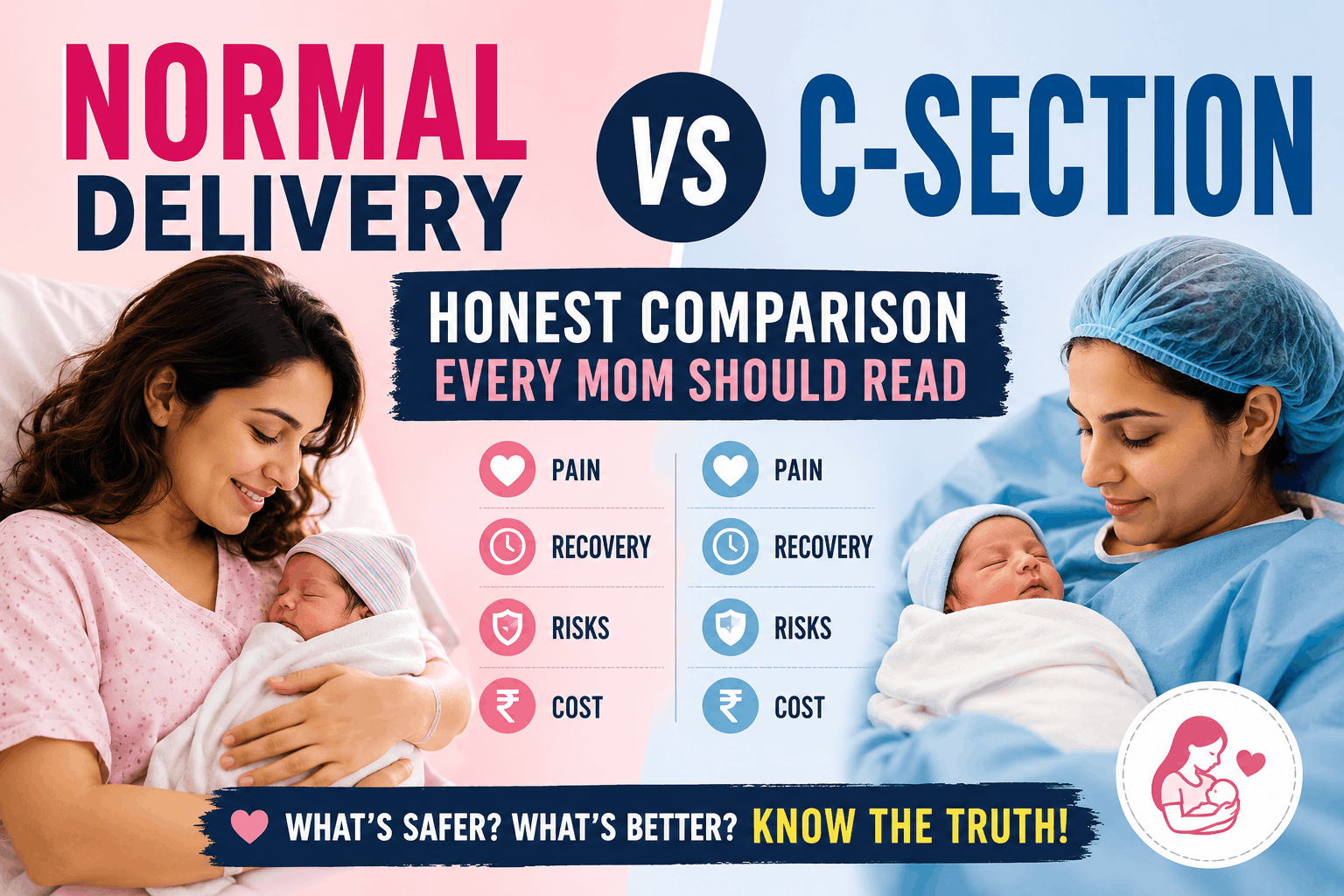
Pregnancy comes with many decisions, but few feel as emotional as deciding—or wondering—how your baby will be born. If you have been searching for normal delivery vs C-section, vaginal delivery vs cesarean, or asking yourself, “Which is better: normal delivery or C-section?”, you are definitely not alone.
Many mothers hear that normal delivery is always better, while others are told that a C-section is easier, safer, or more predictable. The truth is much more nuanced.
Normal delivery and C-section are both established ways to give birth, but neither is universally better. When pregnancy is uncomplicated and there is no medical reason for surgery, vaginal birth is generally an appropriate plan. However, when a medical complication makes vaginal delivery risky for the mother or baby, a C-section may be the safest choice.
So, if you are comparing normal delivery vs C-section, don’t think of it as a competition. The most important goal is a safe delivery and a healthy mother and baby.
This honest guide explains the difference between normal delivery and C-section, including pain, recovery, benefits, risks, baby outcomes, cost considerations in India, VBAC, and when a C-section may actually be necessary.
What Is Normal Delivery?
The term “normal delivery” is commonly used to describe vaginal delivery, where the baby is born through the vagina rather than through abdominal surgery.
During a typical vaginal birth, labor causes the cervix to gradually open. As the cervix dilates, contractions help move the baby down through the birth canal. Once the baby is born, the placenta is delivered afterward.
Vaginal birth can happen spontaneously or after labor induction. It can also involve pain-relief methods such as an epidural. In some situations, an assisted vaginal delivery using a vacuum or forceps may be considered by the medical team.
So, normal delivery does not necessarily mean an unmedicated birth. A mother can have a vaginal delivery and still receive appropriate pain relief and medical support.
How Vaginal Delivery Happens
The process generally involves:
- Labor begins with contractions.
- The cervix gradually dilates.
- The baby moves downward through the birth canal.
- The baby is delivered vaginally.
- The placenta is delivered.
- The mother begins postpartum recovery.
The exact experience varies greatly. Some labors are relatively short, while others take many hours.
Different Types of Vaginal Birth
Vaginal birth can include:
- Spontaneous vaginal delivery
- Induced vaginal delivery
- Vaginal delivery with an epidural
- Assisted vaginal delivery
- Vaginal birth after cesarean, commonly called VBAC
The important point is that vaginal delivery vs C-section is not simply a comparison between “natural” and “unnatural” birth. Both are medical approaches to childbirth, and the appropriate option depends on the individual pregnancy.
What Is a C-Section?
A C-section, also called a cesarean section or cesarean delivery, is a surgical procedure in which the baby is delivered through incisions made in the mother’s abdomen and uterus.
A C-section can be planned ahead of time or become necessary unexpectedly during labor or pregnancy.
Types of C-Section
The two broad categories are:
Planned C-section: The delivery is scheduled in advance because of an identified medical reason or after an individualized discussion with the obstetrician.
Emergency or unplanned C-section: The need for surgery develops during pregnancy or labor because continuing with vaginal delivery may no longer be the safest option.
A C-section is major surgery, even though it is a common and generally safe procedure when performed in an appropriate medical setting.
Why Might a C-Section Be Necessary?
There are several reasons a doctor may recommend cesarean delivery, including:
- Baby is in a breech or another unfavorable position
- Certain placenta problems
- Concerning fetal heart-rate patterns
- Labor is not progressing
- Certain multiple pregnancies
- Certain maternal medical conditions
- Some situations involving a very large baby
- Previous uterine surgery or C-section in circumstances where vaginal birth may not be appropriate
ACOG lists fetal concerns, labor not progressing, placenta problems, breech presentation, certain multiple pregnancies, and some maternal medical conditions among reasons a C-section may be recommended.
The reason matters. A C-section should not be viewed as inherently better or worse than vaginal birth; it should be considered in the context of the mother’s and baby’s individual medical needs.
Normal Delivery vs C-Section: Quick Comparison
| Factor | Vaginal/Normal Delivery | C-Section |
|---|---|---|
| Type of birth | Baby is born through the vagina | Baby is delivered through abdominal and uterine incisions |
| Major surgery | No abdominal surgery | Yes |
| Labor | Usually involves labor | Planned C-section may occur before labor |
| Pain during birth | Labor pain varies; pain relief is available | Anesthesia is used during surgery |
| Recovery | Usually shorter | Generally longer |
| Hospital stay | Often shorter | Usually longer |
| Abdominal incision | No | Yes |
| Surgical risks | Avoids abdominal surgery | Includes risks associated with surgery |
| Vaginal/perineal injury | Possible | Avoided from vaginal birth |
| Future pregnancy considerations | No C-section uterine scar | Uterine scar may affect future pregnancies |
| Can become another delivery method? | Labor can sometimes end in C-section | Some women may later be candidates for VBAC |
Recovery is individual, but C-section generally requires a longer period of healing because the abdomen and uterus have undergone surgery. ACOG notes that abdominal healing takes several weeks following cesarean birth.
Normal Delivery vs C-Section: Which Is Better?
This is probably the biggest question behind searches for normal delivery vs c section which is better.
The honest answer is: there is no universal winner.
For a healthy pregnancy without a medical indication for cesarean delivery, a planned vaginal birth is generally considered an appropriate approach. ACOG’s guidance states that for most low-risk pregnancies, cesarean delivery appears to carry greater maternal morbidity and mortality risk than vaginal delivery.
However, that does not mean vaginal delivery is always safer.
If the baby is showing signs of distress, labor is not progressing appropriately, the placenta is creating a serious problem, or another complication makes vaginal birth unsafe, a C-section can be the safer option.
WHO likewise describes cesarean delivery as an important procedure that can prevent maternal and newborn deaths when medically indicated.
So, if you are wondering is normal delivery better than C-section, the better question is:
“Which delivery method is safest for my pregnancy and my baby?”
That is a question your obstetrician can answer based on your medical history, pregnancy, baby’s position, fetal well-being, labor progress, and other factors.
Normal Delivery vs C-Section: Pain Comparison
Pain is one of the biggest concerns for expecting mothers.
But normal delivery vs C section pain is not as simple as saying one is more painful.
The two types of birth involve pain at different stages.
Does Normal Delivery Hurt More Than C-Section?
During vaginal labor, contractions and cervical dilation can be painful. The intensity varies from woman to woman and can change throughout labor.
However, pain-relief options are available. Depending on the hospital and individual circumstances, these may include:
- Epidural analgesia
- Other medications
- Breathing techniques
- Position changes
- Massage
- Continuous labor support
- Other comfort measures
Therefore, normal delivery does not mean you have to give birth without pain relief.
What About C-Section Pain?
During a C-section, anesthesia is used so that the mother does not experience the surgical pain of the procedure itself.
However, this does not mean a C-section is completely painless.
After the anesthesia wears off, the abdominal incision can be sore or painful. Getting out of bed, coughing, laughing, changing positions, or caring for the baby can initially feel uncomfortable.
ACOG notes that abdominal incision soreness is common during the early recovery period and that pain medication can be used as part of postpartum pain management.
This is why normal delivery vs C section pain should be considered both during birth and during recovery.
Normal Delivery vs C-Section: Recovery Time
Recovery is another major difference between vaginal delivery vs C section recovery.
Normal Delivery Recovery
Many mothers can move around relatively soon after vaginal birth, although recovery depends on whether there were complications.
You may experience:
- Vaginal soreness
- Perineal swelling
- Stitches after a tear or episiotomy
- Postpartum bleeding
- Uterine cramping
- Fatigue
A vaginal birth does not guarantee an easy recovery, but it generally avoids the abdominal healing required after C-section.
C-Section Recovery
C-section recovery involves healing from major abdominal surgery.
You may experience:
- Incision pain or tenderness
- Difficulty moving comfortably initially
- Abdominal soreness
- Postpartum bleeding
- Fatigue
- Temporary numbness around the incision
- Need for additional help with household activities and baby care
ACOG notes that the abdominal incision may remain sore, numb, or uncomfortable during recovery, and that strenuous activity should be limited while healing.
Which Has Faster Recovery?
In general, vaginal delivery has a faster recovery than C-section, although individual recovery can vary.
A mother who has had a complicated vaginal birth may take longer to recover than another mother with an uncomplicated C-section. So, think of recovery as a range rather than a fixed timeline.
Benefits of Normal Delivery
When vaginal birth is medically appropriate, it has several potential advantages.
Shorter Recovery for Many Mothers
Because there is no abdominal surgical incision, many women can return to basic movement and daily activities sooner.
Usually Shorter Hospital Stay
Vaginal birth generally involves less surgical recovery, which may allow for an earlier discharge when mother and baby are doing well.
Avoids Abdominal Surgery
One major benefit is avoiding surgical risks associated with cesarean delivery.
C-section can involve risks such as infection, bleeding, blood clots, anesthesia complications, and injury to nearby organs.
May Make Early Mobility Easier
Being able to move comfortably can be helpful when caring for a newborn, especially during those exhausting first days.
No C-Section Uterine Scar
A vaginal birth does not create a uterine scar from cesarean surgery. This can be relevant when considering future pregnancies.
However, it is important not to turn these benefits into the idea that every vaginal birth is automatically better. Vaginal birth can also involve complications such as tears, pelvic floor symptoms, assisted delivery, postpartum bleeding, or an unplanned C-section.
Benefits of C-Section
The biggest benefit of C-section is not convenience—it is safety when surgery is medically indicated.
A C-section can be lifesaving when continuing with vaginal delivery would pose a serious risk to the mother or baby.
Potential benefits in appropriate situations include:
- Rapid delivery when an urgent situation develops
- Avoiding vaginal birth when it is unsafe
- Providing a planned delivery route for certain pregnancy complications
- Reducing specific risks associated with particular fetal or maternal conditions
For example, C-section may be recommended for certain placenta problems, concerning fetal heart-rate patterns, breech presentation, or labor that has stopped progressing.
A medically necessary C-section is not a failed normal delivery. It is a medical intervention used when its potential benefits outweigh its risks.
Risks of Normal or Vaginal Delivery
It is equally important to be honest about the risks of vaginal birth.
Possible complications include:
- Vaginal or perineal tears
- Swelling and soreness
- Pelvic floor symptoms
- Urinary incontinence
- Fecal incontinence in some women
- Assisted vaginal delivery
- Postpartum bleeding
- Prolonged or difficult labor
- Emergency C-section
The presence or severity of these complications varies widely.
That is why comparing normal delivery vs c section risks should never mean pretending that one method has zero risk.
Childbirth itself carries potential risks for the mother and newborn regardless of the route of delivery.
Risks of C-Section
Because C-section is major surgery, it carries surgical risks.
Potential complications include:
- Infection
- Significant blood loss
- Blood clots
- Reactions to anesthesia or medications
- Injury to the bladder or bowel
- Incision-related problems
- Longer recovery
- Complications in future pregnancies
ACOG notes that cesarean delivery can also increase risks in future pregnancies, including placenta problems, uterine rupture, and, in some situations, hysterectomy. Some risks increase as the number of C-sections increases.
This does not mean C-section is unsafe. It means that, like any major surgery, it has risks that need to be balanced against the reason for performing it.
WHO similarly notes that medically indicated cesarean delivery can save lives, while unnecessary C-sections expose women and babies to avoidable short- and long-term risks.
Normal Delivery vs C-Section for the Baby
Many mothers ask, “Which delivery is better for the baby?”
Again, there is no one-size-fits-all answer.
Vaginal Delivery and Baby
In an uncomplicated pregnancy, vaginal birth can be an appropriate and safe way for a baby to be born.
However, vaginal birth is not automatically the safest option if complications develop.
For example, if there is significant fetal distress or another problem that makes continuing labor unsafe, a C-section may be recommended.
C-Section and Baby
A C-section can be extremely important when the baby needs to be delivered quickly or vaginal delivery presents a significant risk.
At the same time, C-section is not risk-free for newborns. The timing and reason for the C-section matter.
For example, ACOG recommends avoiding nonmedically indicated cesarean delivery before 39 weeks because earlier delivery can increase newborn complications, including respiratory problems.
So, normal delivery or C section which is better for baby depends on the specific pregnancy rather than the delivery method alone.
C-Section vs Normal Delivery for the Mother
When comparing c section vs normal delivery recovery for mother, consider more than just the moment of birth.
Pain
Vaginal birth involves labor pain that can be managed with different approaches. C-section uses anesthesia during surgery but can involve significant postoperative soreness.
Recovery
Vaginal birth generally avoids abdominal surgical healing. C-section requires recovery from surgery.
Hospital Stay
Hospital stays vary, but C-section typically requires more time in hospital than an uncomplicated vaginal birth. ACOG notes that a typical C-section hospital stay is often around 2–4 days, depending on individual circumstances.
Breastfeeding
A C-section does not mean you cannot breastfeed.
If mother and baby are doing well, breastfeeding can usually begin soon after cesarean delivery.
You may simply need additional support finding comfortable positions while your incision heals.
Emotional Experience
Some women feel empowered by vaginal birth. Others feel relieved after a medically necessary C-section. Some women may experience disappointment if their planned delivery method changes unexpectedly.
There is no “right” emotional response.
Your birth experience is personal, and needing a C-section does not make your experience less meaningful.
Normal Delivery vs C-Section Cost in India
If you are comparing normal delivery cost vs C section cost in India, remember that there is no single price that applies to every hospital or city.
The final cost may depend on:
- Hospital
- City
- Doctor
- Room category
- Type of C-section
- Anesthesia
- Medications
- Diagnostic tests
- Length of hospital stay
- Complications
- NICU requirements
- Health insurance coverage
A planned uncomplicated delivery can have a very different bill from a complicated emergency delivery.
Therefore, rather than relying on a single online “average,” ask your hospital for a detailed maternity package and clarify what is included.
Questions worth asking include:
- Is the doctor’s fee included?
- Is anesthesia included?
- Are medications included?
- Are newborn charges included?
- What happens if an emergency C-section becomes necessary?
- What happens if the baby requires NICU care?
- What is excluded from the maternity package?
- Does insurance cover both vaginal and cesarean delivery?
For Indian mothers, this conversation can be especially useful when comparing hospitals before delivery.
When Is a C-Section Necessary?
A C-section may be necessary when vaginal delivery could place the mother or baby at significant risk.
Common reasons include:
- Baby is in a breech position
- Certain placenta complications
- Concerning fetal heart-rate patterns
- Labor is not progressing
- Certain multiple pregnancies
- Certain maternal medical conditions
- Some complications involving the baby’s size or position
- Certain previous uterine surgeries
- Other pregnancy or labor emergencies
ACOG identifies fetal concerns, labor arrest, placenta problems, breech presentation, certain multiple pregnancies, and maternal conditions among possible indications for cesarean birth.
The important word is “may.” Having one of these factors does not mean every woman automatically needs a C-section. Your obstetrician needs to consider the complete clinical picture.
Can You Have a Normal Delivery After a C-Section?
Yes, some women can have a vaginal birth after a previous C-section. This is called VBAC, or Vaginal Birth After Cesarean.
Another term you may hear is TOLAC, which means trial of labor after cesarean.
What Is VBAC?
VBAC means giving birth vaginally after having previously delivered by C-section.
For some women, VBAC can help them avoid another abdominal surgery and its associated recovery.
What Are the Potential Benefits of VBAC?
A successful VBAC may mean:
- Avoiding another C-section
- Shorter recovery
- Less surgical risk
- Less blood loss
- Lower risk of certain complications associated with repeat abdominal surgery
Is VBAC Safe for Everyone?
No.
Whether you can have a normal delivery after C-section depends on several factors, including:
- Type of uterine incision used previously
- Number of previous C-sections
- Reason for the previous C-section
- Current pregnancy
- Current baby’s position
- Other medical conditions
- Availability of appropriate emergency obstetric care
ACOG explains that some women with a previous cesarean can be candidates for vaginal birth, but the decision should be individualized.
If you are considering VBAC after C-section, discuss your individual situation with your obstetrician rather than relying on a general online calculator or story from another mother.
Planned C-Section vs Emergency C-Section
The words “C-section” can describe very different experiences.
Planned C-Section
A planned C-section is scheduled before labor because there is an identified reason to deliver surgically or after an individualized discussion of the options.
You generally have more time to prepare emotionally and practically.
Emergency or Unplanned C-Section
An unplanned C-section may become necessary after labor begins or if a complication develops during pregnancy.
Possible reasons include:
- Concerning fetal heart-rate changes
- Labor that is no longer progressing safely
- Sudden maternal complications
- Placental problems
- Other urgent situations
An emergency C-section does not mean that the mother “did something wrong.” Labor can change quickly, and medical teams sometimes need to change the delivery plan to protect mother or baby.
Common Myths About Normal Delivery and C-Section
Myth 1: “Normal delivery is always better.”
Reality: Vaginal birth is generally an appropriate option for uncomplicated pregnancies without a medical indication for C-section, but it is not automatically the safest choice in every pregnancy.
Myth 2: “A C-section means the mother failed to deliver normally.”
Reality: C-section is a legitimate medical method of delivering a baby and can be lifesaving when medically necessary.
Myth 3: “C-section is completely painless.”
Reality: Anesthesia helps prevent pain during the surgery, but abdominal soreness and pain can occur during recovery.
Myth 4: “Normal delivery means you cannot have an epidural.”
Reality: Vaginal delivery can involve epidural or other forms of pain relief when appropriate.
Myth 5: “Once you have a C-section, you can never have a vaginal birth.”
Reality: Some women may be candidates for VBAC after a previous C-section.
Myth 6: “C-section is always safer for the baby.”
Reality: C-section can be the safest option when medically indicated, but surgery also has risks. The right choice depends on the circumstances.
Questions to Ask Your Doctor Before Choosing a Delivery Plan
If you are unsure about normal delivery or C section, write down your questions before your prenatal appointment.
Ask your obstetrician:
- Is vaginal birth medically appropriate for me?
- Is there any reason I may need a C-section?
- Is my baby currently in a favorable position?
- Are there any concerns about my placenta?
- What factors could change my delivery plan?
- What pain-relief options are available?
- What happens if labor does not progress?
- What are the risks specific to my pregnancy?
- If I have had a previous C-section, am I a VBAC candidate?
- What is the hospital’s emergency C-section protocol?
- How long might recovery take?
- What should I expect during postpartum recovery?
Having these conversations can make you feel more prepared without locking yourself into a delivery plan that may need to change.
How to Prepare for Either Type of Delivery
You can prepare for childbirth without assuming exactly how it will happen.
During Pregnancy
Focus on:
- Regular prenatal appointments
- Understanding your pregnancy risk factors
- Following your healthcare team’s recommendations
- Learning about labor and delivery
- Discussing pain-management options
- Preparing your hospital bag
- Understanding your hospital’s maternity policies
- Making a flexible birth plan
- Discussing what could happen if your delivery plan changes
A birth plan is useful, but it should be flexible.
Prepare Emotionally
Many women experience fear about:
- Labor pain
- C-section surgery
- Losing control during labor
- Emergency procedures
- Not having the birth they imagined
- Family or social-media pressure
Remember that childbirth rarely follows another mother’s exact story.
The goal is not to “win” a normal delivery vs C-section debate.
The goal is to make informed decisions with your healthcare team and remain flexible when circumstances change.
WHO’s guidance on intrapartum care emphasizes woman-centered care and a positive childbirth experience, including appropriate pain-relief options and supportive care during labor.
Which Delivery Method Is Right for You?
There is no online article that can determine the safest delivery method for an individual mother.
However, this simple framework can help:
If your pregnancy is uncomplicated: Vaginal birth may be an appropriate planned approach.
If a medical complication makes vaginal birth unsafe: C-section may provide the safer route.
If complications develop during labor: Your delivery plan may need to change.
If you have had a previous C-section: Discuss VBAC versus repeat C-section with your obstetrician.
If you are afraid of labor pain: Ask about epidural and other pain-relief options rather than choosing surgery solely because of fear. ACOG specifically recommends discussing pain-relief options with an obstetrician when fear of childbirth is influencing delivery preferences.
The best delivery method is the one that makes sense for your specific medical circumstances.
Normal Delivery vs C-Section: Final Verdict
So, normal delivery vs C section—which is better?
For an uncomplicated, low-risk pregnancy, vaginal delivery is generally an appropriate option and avoids the risks of abdominal surgery. C-section, however, can be the safest and sometimes lifesaving option when a medical indication exists.
A simple way to remember the comparison is:
Normal/Vaginal Delivery: Generally avoids major abdominal surgery and usually has a shorter recovery, but labor and vaginal birth have their own potential complications.
C-Section: Is major surgery with a longer recovery and surgical risks, but it can be the safest option when vaginal delivery could put the mother or baby at risk.
There is no universal answer to normal delivery or C section which is better.
And perhaps the most important message for every expecting mother is this:
A healthy mother and healthy baby matter more than the label attached to the birth.
A planned vaginal birth that becomes a medically necessary C-section is not a failure. A planned C-section that protects a mother or baby is not a lesser birth. Your birth story is yours, and the safest medically appropriate outcome should always come first.
Frequently Asked Questions
Which is better, normal delivery or C-section?
Neither is universally better. For most low-risk pregnancies without a medical indication for cesarean delivery, vaginal birth is generally an appropriate approach. C-section may be safer when a medical complication makes vaginal birth risky.
Is normal delivery safer than C-section?
For many low-risk pregnancies, vaginal delivery has lower maternal surgical risk because it avoids major abdominal surgery. However, C-section can be safer or lifesaving when medically indicated.
Is C-section more painful than normal delivery?
The pain occurs differently. Vaginal delivery can involve significant labor pain, while C-section is performed with anesthesia but can cause abdominal pain and soreness during recovery.
Which has a faster recovery, vaginal delivery or C-section?
Vaginal delivery generally has a faster recovery because it does not require abdominal surgical healing. Individual recovery varies depending on complications and the mother’s overall health.
Which delivery is better for the baby?
Neither method is automatically better for every baby. The safest route depends on the pregnancy and circumstances at delivery. When a medical complication makes vaginal birth dangerous, C-section may be the safest option.
Why do doctors recommend C-section?
Doctors may recommend C-section when there are concerns such as fetal distress, certain placenta problems, breech presentation, labor not progressing, certain multiple pregnancies, or maternal conditions that make vaginal birth risky.
When is C-section necessary?
A C-section may be necessary when vaginal delivery would pose an unacceptable risk to the mother or baby. The exact indications vary from one pregnancy to another.
Can I have a normal delivery after C-section?
Some women can have a vaginal birth after C-section, known as VBAC. Eligibility depends on factors such as the previous uterine incision, number of previous C-sections, current pregnancy, and available medical resources.
How long does C-section recovery take?
Recovery varies, but abdominal healing takes several weeks. ACOG advises limiting strenuous activity during recovery and following individualized postpartum instructions from the healthcare team.
Does C-section affect future pregnancies?
Yes, a previous C-section can affect future pregnancy risks. Certain placenta problems and uterine complications can become more relevant, and some risks increase with multiple C-sections.
Can I breastfeed after a C-section?
Yes. If the mother and baby are doing well, breastfeeding can generally begin soon after C-section. Additional positioning support may be helpful while the abdominal incision heals.
Is normal delivery possible after one C-section?
It may be possible for some women. This is known as VBAC, but suitability should be assessed individually by an obstetrician.
Does normal delivery cause pelvic floor problems?
Vaginal birth can be associated with pelvic floor symptoms, including urinary incontinence in some women. However, pelvic floor outcomes are influenced by multiple factors, and this does not mean every woman who has a vaginal delivery will develop pelvic floor problems.
Can a planned normal delivery turn into a C-section?
Yes. Labor can develop complications that make a C-section the safer option. A flexible birth plan should account for this possibility.
Is C-section safe?
C-section is a common surgical procedure and can be very safe when appropriately performed and medically indicated. However, it is major surgery and carries risks such as infection, bleeding, blood clots, anesthesia complications and future pregnancy risks.
Key Takeaways for Expecting Moms
- Normal delivery and C-section are both established ways to give birth.
- There is no universally best delivery method.
- Vaginal birth generally avoids major abdominal surgery and often has a shorter recovery.
- C-section is major surgery and usually requires a longer recovery.
- C-section can be lifesaving when medically necessary.
- Vaginal birth also has possible complications and is not completely risk-free.
- A previous C-section does not automatically rule out VBAC.
- C-section does not mean a mother has failed.
- Your birth plan should be flexible because pregnancy and labor can change.
- The safest delivery method depends on your individual pregnancy and should be discussed with your obstetrician.
Medical Disclaimer: This article is intended for general educational purposes and should not replace personalized medical advice. Every pregnancy, labor and delivery is different. Speak with your obstetrician or another qualified healthcare professional about the safest delivery option for you and your baby.