
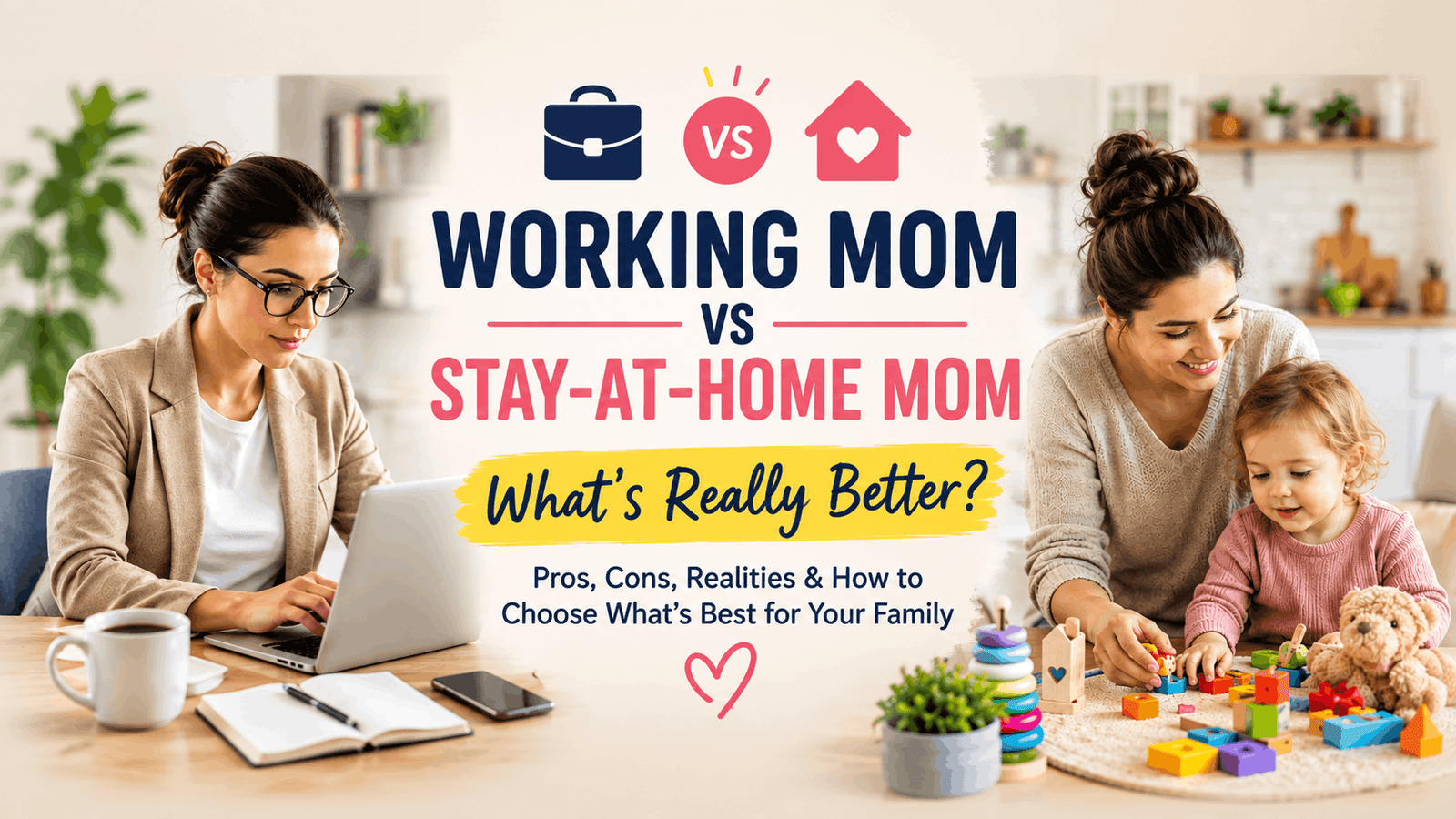
Choosing between being a working mom vs stay-at-home mom is one of the biggest decisions many mothers face after having a baby. Should you return to work after maternity leave? Should you quit your job and become a stay-at-home mom? Would your child be better off if you stayed home? Or can you be a great mother while continuing your career?
The truth is that there is no universal answer.
A working mom may benefit from financial independence, career growth, professional identity and personal fulfillment. A stay-at-home mom may have more flexibility, more daytime time with her children and greater control over daily routines. Both choices come with benefits, challenges and sacrifices.
So, is it better to be a working mom or stay-at-home mom? The best choice depends on your family’s finances, childcare arrangements, career goals, support system, child’s needs and your own physical and emotional well-being.
Most importantly, motherhood is not a competition. A mother does not become a better parent simply because she works outside the home or stays home with her children.
What Is the Difference Between a Working Mom and a Stay-at-Home Mom?
Before comparing a working mother vs stay-at-home mother, it helps to understand that today’s mothers do not necessarily fit into just two categories.
What Is a Working Mom?
A working mom is a mother who earns an income through employment, business or another form of paid work while also raising her children.
Working moms can include:
- Full-time working mothers
- Part-time working mothers
- Work-from-home moms
- Hybrid working moms
- Freelancers
- Entrepreneurs
- Self-employed mothers
- Mothers working flexible or seasonal schedules
Being a working mom does not necessarily mean spending most of the day away from your children. A mother working remotely or part-time may have a very different experience from someone working long hours and commuting several hours every day.
What Is a Stay-at-Home Mom?
A stay-at-home mom, often called a SAHM, is a mother who primarily stays home to care for her children rather than working in a traditional paid job.
Her responsibilities may include:
- Childcare
- Preparing meals
- Managing household routines
- Taking children to appointments and activities
- Helping with learning and development
- Managing school-related responsibilities
- Household organization
- Emotional support and caregiving
Being a stay-at-home mom does not mean that a mother is not working. Childcare and household management can involve significant time, effort and responsibility, even though they are generally unpaid.
The Rise of Flexible Motherhood
The modern conversation around working mom vs stay at home mom has also changed because mothers now have more flexible work options.
Instead of choosing only between a full-time career and staying home permanently, some mothers choose:
- Remote work
- Hybrid jobs
- Part-time employment
- Freelancing
- Consulting
- Entrepreneurship
- Flexible working hours
- Job sharing
- Reduced schedules
This means the decision does not always have to be “career or children.” Sometimes, families can create a middle-ground arrangement that works better for everyone.
Working Mom vs Stay-at-Home Mom: Quick Comparison
| Factor | Working Mom | Stay-at-Home Mom |
|---|---|---|
| Income | Provides additional income | Usually relies primarily on one income |
| Career | Career generally continues | Career may pause or change |
| Childcare | May require daycare, nanny or family support | Parent provides most daytime care |
| Family time | Often concentrated around mornings, evenings and weekends | More daytime availability |
| Financial independence | Usually higher | May be reduced |
| Household responsibilities | Usually shared or outsourced | Often more concentrated at home |
| Career growth | Can continue | May involve a career gap |
| Flexibility | Depends on job and employer | Often greater control over schedule |
| Personal identity | Career and motherhood | Motherhood plus other personal roles |
| Childcare expenses | May be significant | May be lower, depending on circumstances |
Neither option automatically wins this comparison.
The better question is not “working mom or stay-at-home mom—which is better?” but rather “Which arrangement works best for our family?”
Pros and Cons of Being a Working Mom
Being a working mom can provide important personal, professional and financial benefits. At the same time, balancing employment and motherhood can be demanding.
Benefits of Being a Working Mom
1. Financial Independence
One of the biggest benefits of being a working mom is having your own source of income.
A second income can potentially help a family with:
- Monthly household expenses
- Childcare
- Education
- Savings
- Investments
- Emergency funds
- Family vacations
- Retirement planning
Financial independence can also provide a mother with greater personal security and confidence.
However, the financial benefit of working should be calculated after considering childcare, commuting, work-related expenses and other costs.
2. Career Growth
Continuing to work can help mothers maintain their professional skills and career momentum.
Depending on the profession, staying employed may provide opportunities for:
- Promotions
- Salary increases
- Networking
- Professional development
- Leadership opportunities
- New skills
- Retirement benefits
For a mother who genuinely enjoys her career, continuing to work can be an important part of her identity.
3. A Sense of Identity Outside Motherhood
Motherhood can be incredibly fulfilling, but it does not have to become a mother’s entire identity.
A career can provide:
- Personal goals
- Social interaction
- Professional achievements
- Intellectual stimulation
- Financial independence
- A sense of accomplishment
For some women, continuing their careers actually helps them feel more balanced and fulfilled.
4. More Shared Financial Responsibility
When both parents earn an income, the family may have more flexibility in managing expenses and planning for the future.
A dual-income household may have more capacity to contribute toward:
- Children’s education
- Home ownership
- Investments
- Retirement
- Insurance
- Emergency savings
Of course, every family’s financial situation is different.
5. Modeling Work and Independence for Children
Children can observe their mother’s dedication, responsibility and work ethic.
A working mother may model important values such as:
- Independence
- Responsibility
- Time management
- Perseverance
- Goal setting
- Financial awareness
Having a working mom does not mean children receive less love or attention.
Challenges of Being a Working Mom
The biggest challenge for many working mothers is not necessarily work itself. It is managing multiple responsibilities simultaneously.
Common challenges include:
- Work-life balance
- Childcare costs
- Long commutes
- Workplace pressure
- Limited family time
- Mom guilt
- Mental load
- Household responsibilities
- Sick days
- School holidays
- Managing deadlines while caring for children
A mother may spend the day meeting professional responsibilities and then return home to another round of cooking, cleaning, homework, bedtime and childcare.
This is why the question “working mom vs stay at home mom which is harder?” does not have a simple answer. The challenges are simply different.
Pros and Cons of Being a Stay-at-Home Mom
Being a stay-at-home mom can offer greater daytime availability and flexibility, but it also comes with financial, emotional and career-related considerations.
Benefits of Being a Stay-at-Home Mom
1. More Time With Children
One of the biggest advantages of being a stay-at-home mom is having more opportunities to participate in everyday moments.
This can include:
- Breakfast together
- Playtime
- Reading
- Outdoor activities
- School drop-offs and pickups
- Meals
- Nap routines
- Bedtime routines
- Doctor appointments
For some mothers, being present for these everyday moments is extremely important.
2. Greater Control Over the Child’s Routine
A stay-at-home mother may have greater control over:
- Meals
- Sleep schedules
- Screen time
- Learning activities
- Play
- Outdoor time
- Daily routines
This can make certain aspects of parenting easier to organize.
3. Potential Childcare Savings
If a mother provides most of the childcare herself, the family may reduce or eliminate some daycare or nanny expenses.
However, this should not be interpreted as meaning that staying home is automatically cheaper.
A family also needs to consider the income the mother gives up, career progression, retirement contributions and long-term earning potential.
4. Greater Schedule Flexibility
A stay-at-home mom may have more flexibility for:
- Doctor visits
- School activities
- Sick days
- Family emergencies
- Children’s appointments
- School holidays
This can be particularly helpful when children are very young.
5. More Time to Manage Family Responsibilities
Some families find that having one parent primarily responsible for daytime childcare makes household logistics easier.
Meal preparation, appointments, errands and children’s activities can sometimes be organized more easily when one parent has greater daytime availability.
Challenges of Being a Stay-at-Home Mom
Being a stay-at-home mom can be rewarding, but it is not necessarily easier.
Potential challenges include:
- Loss of personal income
- Career interruption
- Reduced financial independence
- Difficulty returning to work
- Social isolation
- Constant caregiving
- Repetitive household responsibilities
- Mental load
- Lack of clear working hours
- Financial dependence on a partner
One of the biggest misconceptions about stay-at-home mom life is that staying home means having plenty of free time.
Caring for a baby or young child can be a full-day responsibility, and many stay-at-home mothers have very little uninterrupted personal time.
Working Mom vs Stay-at-Home Mom: Which One Is Harder?
This is one of the most common questions in the working mom vs stay at home mom debate.
The honest answer is: neither is automatically harder for every mother.
A working mother may struggle with:
- Time scarcity
- Workplace deadlines
- Childcare
- Commuting
- Household responsibilities
- Mom guilt
A stay-at-home mother may struggle with:
- Constant childcare
- Lack of personal breaks
- Isolation
- Financial dependence
- Career uncertainty
- Household mental load
For one mother, going to work may provide valuable adult interaction and a sense of identity. For another, the idea of leaving her child every morning may be emotionally difficult.
Personal preferences matter.
Working Mom vs Stay-at-Home Mom: Which Is Better Financially?
Financial considerations can have a major influence on the decision.
At first glance, having two incomes may appear to be the obvious financial choice. However, the actual calculation is more complicated.
Financial Benefits of Being a Working Mom
A working mother may contribute:
- Salary
- Bonuses
- Employer benefits
- Retirement contributions
- Health insurance
- Career progression
- Future earning potential
Financial Benefits of Being a Stay-at-Home Mom
A stay-at-home arrangement may reduce certain expenses such as:
- Daycare
- Nanny costs
- Commuting
- Work clothing
- Meals outside the home
- Some work-related expenses
But families also need to account for the opportunity cost of leaving paid employment.
How to Calculate the Real Cost of Working
A simple starting point is:
Take-home income − childcare − commuting − work expenses − additional household costs = effective financial benefit of working
But don’t stop there.
Also consider:
- Retirement savings
- Employer benefits
- Future salary increases
- Career progression
- Insurance
- Long-term earning potential
This makes the question “working mom vs stay at home mom financially—which is better?” much more complicated than simply comparing monthly salaries.
Working Mom vs Stay-at-Home Mom: What About the Child?
One of the biggest concerns mothers have is whether working will negatively affect their children.
Does Having a Working Mom Negatively Affect Children?
Not necessarily.
Being a working mom does not automatically mean that a child will have a weaker relationship with their mother or experience poorer outcomes.
Children are influenced by many factors, including:
- Quality of caregiving
- Emotional connection
- Family stability
- Responsive parenting
- Quality of childcare
- Family finances
- Parental stress
- Consistency
- Overall home environment
A mother can work and still provide a loving, responsive and secure relationship with her child.
Are Children Better Off When a Parent Stays Home?
There is no universal yes-or-no answer.
Having a parent at home can provide more direct daytime care, but the overall family environment matters too.
A stay-at-home arrangement may become difficult if the parent is extremely isolated, overwhelmed or financially stressed.
Similarly, a working arrangement may become difficult if parents face extreme work pressure, inadequate childcare or chronic exhaustion.
The goal should be to create a family environment where children receive consistent care, affection, safety and emotional support.
Does Daycare Harm Children?
It is not accurate to say that daycare automatically harms children.
The quality and consistency of childcare matter greatly.
Parents should consider:
- Caregiver-to-child ratios
- Staff qualifications
- Safety standards
- Cleanliness
- Consistency of caregivers
- Hours spent in care
- Child’s temperament
- Quality of interaction
- Communication between parents and caregivers
A high-quality childcare arrangement can become an important part of a family’s support system.
Working Mom vs Stay-at-Home Mom for Babies
The decision can feel particularly difficult during the first year.
Babies require frequent feeding, sleep support, diaper changes, comfort and responsive care.
Working After Maternity Leave
Returning to work after maternity leave can involve practical challenges such as:
- Finding reliable childcare
- Breastfeeding or pumping
- Adjusting to a new routine
- Managing baby’s sleep
- Handling sick days
- Coping with separation anxiety
- Balancing work responsibilities
For some mothers, returning to work can also bring a positive sense of identity and routine.
Staying Home With a Baby
Staying home with a baby may provide more direct involvement in:
- Feeding
- Sleep routines
- Play
- Development
- Appointments
- Daily caregiving
But it can also mean spending long periods without adult interaction and having very little personal time.
What Matters Most During the First Year?
Whether the mother works or stays home, babies benefit from:
- Responsive caregiving
- A safe environment
- Consistent routines
- Emotional connection
- Appropriate nutrition
- Adequate sleep
- Opportunities for interaction and development
The specific employment status of the mother is only one part of the larger picture.
Working Mom vs Stay-at-Home Mom for Toddlers
The working mom or stay at home mom for toddlers question brings another set of considerations.
Toddlers are becoming increasingly mobile, curious and independent. They need opportunities for:
- Play
- Language development
- Social interaction
- Physical activity
- Exploration
- Consistent routines
- Emotional support
A stay-at-home mother may provide these opportunities directly at home.
A working mother may rely on daycare, preschool, grandparents, a nanny or another caregiver.
Neither arrangement automatically determines whether a toddler will thrive.
The quality of interaction, caregiving and environment matters more than simply whether the mother has a job.
How Work-Life Balance Changes the Decision
When comparing a working mom vs stay-at-home mom, don’t only ask whether the mother works.
Ask what kind of work she does.
There is a major difference between:
A High-Stress Working Arrangement
- Long commute
- Long working hours
- Unpredictable schedule
- Limited leave
- Little flexibility
- Frequent overtime
and:
A Family-Friendly Working Arrangement
- Remote work
- Hybrid work
- Flexible hours
- Predictable schedule
- Supportive employer
- Family-friendly leave policies
A flexible working mom may have more opportunities to spend time with her children than a mother working a demanding job with a long commute.
This is why work-life balance for moms should be considered separately from employment status.
What If You Could Be a Part-Time or Flexible Working Mom?
You don’t necessarily have to choose between being a full-time working mother and becoming a stay-at-home mom.
A middle-ground approach may work for some families.
Options include:
- Part-time employment
- Freelancing
- Remote work
- Hybrid work
- Consulting
- Entrepreneurship
- Flexible shifts
- Job sharing
- Reduced working hours
For some mothers, this arrangement provides a balance between maintaining a career and having more time with children.
However, flexibility should not automatically mean taking on two full-time jobs. A part-time job combined with full-time household and childcare responsibilities can still become exhausting.
10 Questions to Ask Before Choosing
If you’re trying to decide “should I be a working mom or stay at home mom?”, ask yourself these questions.
1. Can our family comfortably live on one income?
Look beyond today’s expenses and consider savings, emergencies, education and retirement.
2. What would childcare actually cost?
Get real numbers for daycare, nanny care, transportation and backup childcare.
3. Do I enjoy my career?
If your career gives you fulfillment, leaving it may affect your well-being.
4. How flexible is my job?
Remote work, flexible hours and family-friendly policies can dramatically change the experience of being a working mom.
5. Do I want to continue building my career?
Think about where you want to be professionally five or ten years from now.
6. What childcare support do we have?
Consider:
- Partner
- Grandparents
- Relatives
- Daycare
- Nanny
- Babysitter
- Community support
7. How would staying home affect retirement savings?
Don’t forget long-term financial planning.
8. How would I feel about a career break?
Some women enjoy stepping away from work temporarily. Others find it emotionally difficult.
9. How does my partner share parenting and household responsibilities?
Being a stay-at-home mom should not automatically mean becoming responsible for every household task.
10. Which lifestyle would be more sustainable for our family?
This may be the most important question.
Don’t choose based only on what looks ideal. Choose what you can realistically maintain.
Should I Quit My Job to Become a Stay-at-Home Mom?
If you’re seriously considering becoming a stay-at-home mom, avoid making the decision based only on emotions.
Before resigning, consider:
- Emergency savings
- Monthly household expenses
- Health insurance
- Retirement planning
- Career gap
- Future earning potential
- Childcare costs
- Partner’s income stability
- Your personal goals
- A potential return-to-work plan
Try a Temporary Arrangement First
If possible, consider whether you can test the arrangement before permanently leaving your job.
Potential options include:
- Extended leave
- Reduced hours
- Remote work
- Part-time work
- Flexible schedules
- A temporary career break
This can help you understand what daily life will actually feel like before making a permanent decision.
How to Make Being a Working Mom Easier
Being a working mom doesn’t have to mean doing everything yourself.
Create a Realistic Morning Routine
Prepare clothes, bags, meals and essentials the night before.
Prepare Meals in Advance
Batch cooking and simple meals can reduce weekday stress.
Share Household Responsibilities
Childcare and household work should not automatically become the mother’s responsibility just because she is the one who manages the children.
Use Childcare Strategically
Reliable childcare can make the difference between an unsustainable routine and a manageable one.
Set Work Boundaries
Whenever possible, establish clear working hours and protect family time.
Stop Trying to Be Perfect
You don’t need a perfectly clean home, homemade meals every day and a perfectly organized schedule.
Batch Errands
Group errands together instead of making multiple trips.
Protect One-on-One Time
Even a short period of uninterrupted connection with your child can become meaningful.
Ask for Help
Support is not failure. It is part of building a sustainable family routine.
How to Make Being a Stay-at-Home Mom Easier
Stay-at-home motherhood can also become overwhelming without support.
Create Flexible Routines
A routine can provide structure without making every hour rigid.
Build a Support Network
Connect with:
- Other mothers
- Family members
- Parent groups
- Neighbors
- Community activities
Schedule Personal Time
Your own hobbies, friendships and interests still matter.
Maintain Professional Skills
If you may want to return to work, consider:
- Online courses
- Certifications
- Networking
- Freelancing
- Professional reading
- Skill development
Consider Part-Time or Side Income If You Want
A small business, freelance work or flexible side income may provide financial independence without requiring a traditional full-time job.
Plan for Retirement
Staying home does not eliminate the need for long-term financial planning.
Share Household Responsibilities
A stay-at-home mom is already providing childcare. That does not mean she must automatically handle every household responsibility alone.
Can You Be a Good Mom and Have a Career?
Absolutely.
Being a good mom is not determined by whether you receive a salary.
A working mother can be loving, emotionally available and deeply involved in her child’s life.
The important things include:
- Connection
- Consistency
- Emotional support
- Responsive parenting
- Quality time
- Safety
- Trust
- Communication
Working does not mean choosing your career over your child.
A mother can care deeply about both.
Can You Be a Good Stay-at-Home Mom Without Losing Yourself?
Absolutely.
One challenge of stay-at-home mom life is that motherhood can become so all-consuming that a woman stops making time for herself.
Remember that you are still a person with:
- Interests
- Friendships
- Goals
- Skills
- Hobbies
- Dreams
- Personal ambitions
Try to maintain activities that make you feel like yourself.
This could mean reading, exercising, meeting friends, learning something new, volunteering, starting a small business or simply having uninterrupted time alone.
Motherhood is an important part of your identity, but it does not have to be your entire identity.
The Best Choice May Change as Your Children Grow
One of the biggest mistakes in the working mom vs stay-at-home mom debate is assuming that the decision must remain permanent.
Your family’s needs can change.
Baby Stage
You may prefer:
- Maternity leave
- Flexible work
- Remote work
- Staying home temporarily
Toddler Years
You may explore:
- Daycare
- Preschool
- Part-time work
- Flexible schedules
School Years
Your priorities may shift toward:
- School schedules
- After-school activities
- Career development
- Homework
- Family routines
Teenage Years
You may have more opportunities to:
- Increase working hours
- Restart a career
- Pursue professional goals
- Focus on long-term financial planning
A mother might stay home for two years and return to work later.
Another mother might continue working throughout her child’s childhood.
Another might move from full-time work to part-time work and then back again.
There is no requirement to make one decision forever.
Working Mom vs Stay-at-Home Mom: The Verdict
So, is it better to be a working mom or stay-at-home mom?
Neither is universally better.
A working mom may benefit from financial independence, career fulfillment, professional identity and additional income. A stay-at-home mom may have more daytime flexibility, direct involvement in childcare and greater control over the family’s daily routine.
Both choices come with challenges.
The best decision depends on:
- Your family’s finances
- Childcare options
- Your career goals
- Your child’s needs
- Your partner’s involvement
- Your support system
- Your work flexibility
- Your personal preferences
- Your emotional well-being
The most important thing is to create an arrangement that is sustainable, supported and healthy for your family.
A working mom is not choosing her career over her children.
A stay-at-home mom is not giving up on ambition.
Both are making choices based on the circumstances of their families.
And remember: there is no single definition of a good mother.
Frequently Asked Questions
Is it better to be a working mom or stay-at-home mom?
Neither is automatically better. The right choice depends on your family’s finances, childcare options, career goals, support system, child’s needs and your own well-being. A working mom may benefit from career and financial independence, while a stay-at-home mom may have more daytime flexibility and direct involvement in childcare.
Are children happier when their mom stays home?
Not necessarily. Children’s well-being depends on many factors, including the quality of caregiving, emotional connection, family stability, childcare quality and parental well-being. Having a stay-at-home mom can provide more daytime availability, but it is not a guarantee that children will be happier.
Does being a working mom affect children negatively?
Being a working mom does not automatically have a negative effect on children. What matters includes the quality of caregiving, emotional connection, family environment, childcare arrangements and parental stress. Working mothers can maintain strong, loving relationships with their children.
What are the disadvantages of being a working mom?
Common challenges include childcare costs, time pressure, commuting, workplace stress, limited family time, mom guilt and managing household responsibilities alongside a career. The experience varies significantly depending on work hours, flexibility, childcare and family support.
What are the disadvantages of being a stay-at-home mom?
Potential disadvantages include loss of personal income, career interruption, reduced financial independence, difficulty returning to work, social isolation and the constant demands of childcare and household management. These challenges can be reduced with financial planning and a strong support system.
Is being a stay-at-home mom harder than working?
There is no universal answer. Working moms often experience time pressure, career demands and childcare challenges, while stay-at-home moms may experience constant caregiving, isolation and a lack of personal breaks. Both roles involve significant responsibilities, but the challenges are different.
Are working moms happier than stay-at-home moms?
There is no simple answer because happiness depends on individual circumstances. Some women find career fulfillment through employment, while others find greater satisfaction in being home with their children. Personal preference, financial security, social support and work-life balance can all influence well-being.
Should I quit my job to become a stay-at-home mom?
Before quitting, consider your family’s finances, emergency savings, insurance, retirement planning, childcare costs, career goals and future earning potential. If possible, explore alternatives such as remote work, reduced hours, flexible schedules or a temporary leave before making a permanent decision.
Is it financially better to be a working mom?
It depends. A working mom may contribute additional income, retirement savings and employer benefits, but childcare, commuting and work-related expenses can reduce the immediate financial benefit. Families should compare the complete financial picture rather than looking only at salary.
Can a working mom still be present for her children?
Yes. Being present is not only about the number of hours spent together. Emotional connection, responsive parenting, quality time and consistency matter too. Flexible schedules, remote work, shared parenting and reliable childcare can help working mothers remain actively involved in their children’s lives.
Can a stay-at-home mom return to work later?
Yes. Many mothers return to employment after spending time at home with their children. Maintaining professional skills, networking, taking courses and exploring freelance or part-time opportunities during a career break can make a future transition easier.
What is the best option for a baby: working mom or stay-at-home mom?
There is no universal best option. Babies need safe, responsive and consistent care, emotional connection and appropriate nutrition and sleep support. A baby can thrive with a working mother and quality childcare or with a stay-at-home mother, depending on the family’s circumstances.
Final Thoughts
The working mom vs stay-at-home mom debate often makes mothers feel as though they have to choose the “perfect” option.
But perfect motherhood does not exist.
Some families need two incomes. Some families prefer one parent at home. Some mothers love their careers. Others genuinely want to spend their days raising their children. Some families change their approach as their children grow.
What matters most is finding a setup that allows your family to function well without sacrificing your financial security, relationships or well-being.
Whether you are a working mom, stay-at-home mom, part-time mom, work-from-home mom or somewhere in between, your choice does not determine how much you love your child.
The best choice is the one that works for your family.