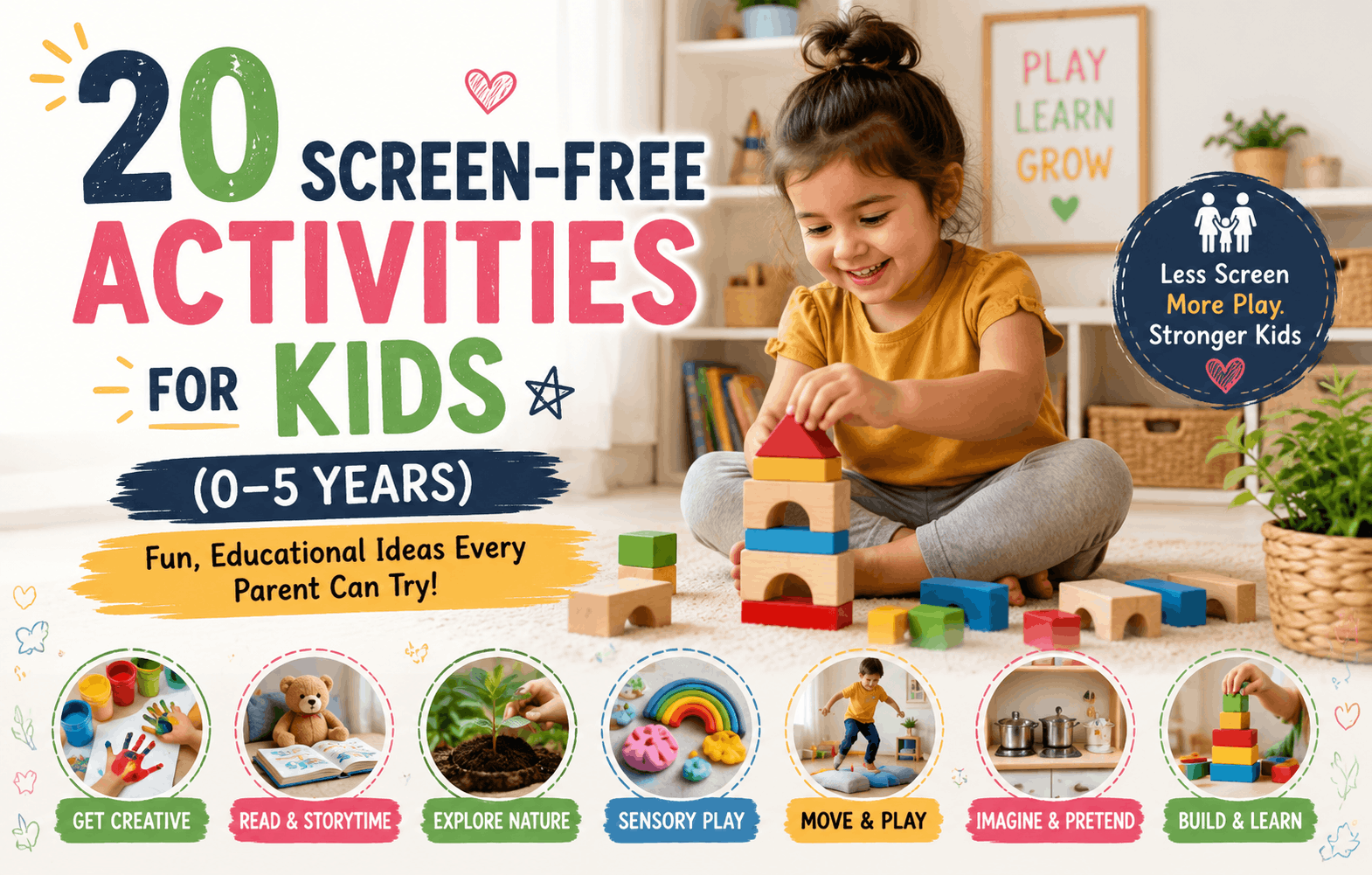


Keeping a toddler busy without reaching for a phone or tablet sounds simple until you actually have dinner on the stove, emails waiting, laundry to fold, or a child following you from room to room saying, “I’m bored.”
The problem usually isn’t that parents don’t have enough activities.
It’s that most parents don’t have enough easy activities that fit into real life.
A complicated craft that requires 15 minutes of preparation isn’t very helpful when you have five minutes before dinner. A huge list of educational activities can feel overwhelming when your toddler is already tired. And expecting a young child to happily play independently for an hour isn’t realistic for every child.
Screen-free parenting doesn’t have to mean eliminating every screen or keeping your toddler entertained every minute of the day. The goal is simply to create more opportunities for play, movement, conversation, creativity, and exploration.
The CDC notes that young children learn through talking, playing, and interacting with others, and its guidance for toddlers includes simple activities such as reading, pretend play, songs, puzzles, blocks, movement, and helping with everyday tasks.
So instead of asking, “How can I keep my toddler entertained all day?” try asking:
“What is one simple thing my toddler can do while I finish this task?”
That small change makes screen-free time much more manageable.
Why Keeping Toddlers Busy Can Be So Difficult
Toddlers are curious, active, and increasingly independent. They want to explore everything, but they also have short attention spans and still need plenty of interaction with adults.
That’s why an activity that works perfectly on Monday may be completely ignored on Tuesday.
There is also a big difference between an activity that looks impressive on Pinterest and one that actually works in a busy household.
Parents usually need activities that are:
- Quick to set up
- Easy to clean up
- Appropriate for the child’s age
- Made from materials already available
- Flexible enough to adapt
- Safe for the situation
- Interesting without requiring constant adult entertainment
And sometimes, the best activity is surprisingly simple.
A few plastic cups can become a building challenge. A cardboard box can become a bus. A basket of books can create quiet time. A pillow can become part of an indoor obstacle course.
You don’t always need another toy.
1. Create a Small “Activity Rotation”
One of the easiest ways to reduce screen dependence is to stop trying to come up with a new activity every time your toddler gets bored.
Instead, create a small rotation.
You might keep five or six options available:
- Books
- Blocks
- Drawing supplies
- A simple puzzle
- Pretend-play materials
- One sensory or hands-on activity
You don’t need to put everything out at once.
Keep some activities stored away and rotate them every few days. Something your toddler hasn’t seen for several days may suddenly feel interesting again.
The important part is keeping the system simple enough that you actually use it.
A parent shouldn’t need a spreadsheet to organize toddler play.
2. Give Your Toddler a “Special Job” While You Cook
Cooking is one of the hardest times for parents because your attention is divided.
Instead of trying to entertain your toddler while preparing dinner, sometimes give them a small, safe household job.
Depending on their age and abilities, they might:
- Fold napkins
- Put clean plastic cups into a basket
- Sort kitchen towels by color
- Match container lids
- Put safe items into a pretend shopping bag
- Wipe a child-sized table with a dry cloth
- Pretend to prepare food in a play kitchen
The key word is safe.
Toddlers should never be treated as kitchen helpers around hot surfaces, sharp knives, boiling water, appliances, or other hazards.
If you need practical screen-free ideas specifically for those difficult cooking moments, a useful approach is to prepare one simple activity in a safe area before you start cooking. For example, these toddler activities for while you’re cooking use simple materials and focus on keeping the child away from cooking hazards.
The goal isn’t to make your toddler independent enough that you can completely ignore them.
It’s simply to give them something meaningful to do while you complete a necessary task.
3. Turn a Cardboard Box Into Almost Anything
Before buying another toy, look around the house.
A cardboard box can become:
- A bus
- A grocery store
- A garage
- A dollhouse
- A spaceship
- A delivery truck
- A puppet theater
- A hiding place
- A pretend oven
You can make the setup even easier by giving your toddler a simple challenge.
“Where should the passengers sit?”
“What should we deliver?”
“Can you make a garage for your cars?”
“What should we put inside the spaceship?”
The box provides the physical object. Your questions provide the beginning of the story.
After that, let your toddler take over.
4. Try a Simple Color Hunt
Color hunts require almost no preparation.
Choose one color and ask:
“Can you find three blue things?”
Your toddler can walk around the room looking for objects.
For younger toddlers, start with one or two colors. For older preschoolers, make it more challenging:
- Find something red
- Find something soft
- Find something round
- Find something that starts with B
- Find something smaller than your hand
This activity can be adjusted to your child’s age without changing the basic setup.
And it doesn’t require special educational materials.
5. Build With Cups
You don’t necessarily need expensive building toys.
A stack of sturdy plastic cups can become a surprisingly engaging activity.
Let your toddler:
- Stack them
- Knock them down
- Build a tower
- Make two towers
- Sort them by color
- Put small toys inside larger cups when appropriate
- Build a “house” for stuffed animals
You can occasionally add a challenge:
“Can you make a tower taller than this?”
Then let your toddler experiment.
The point isn’t whether they build the tallest tower.
The point is that they are manipulating objects, testing ideas, and figuring out what happens when something falls.
6. Make an Indoor Movement Course
Sometimes your toddler isn’t bored.
They’re simply full of energy.
If the weather is bad or you can’t get outside, create a simple movement course using safe household items.
For example:
Pillow → walk around chair → crawl under blanket → touch the wall → jump three times
You don’t need gym equipment.
Pillows, cushions, blankets, and open floor space can be enough.
You can also turn it into an animal game:
- Walk like a bear
- Hop like a bunny
- Waddle like a penguin
- Stomp like an elephant
- Crawl like a turtle
For safety, remove obstacles that could cause falls and keep the activity appropriate for your child’s abilities.
7. Let Them Help With Laundry
Laundry is another household task that can become an opportunity for play.
Give your toddler a small pile of clean clothes and ask them to sort:
- Socks
- Towels
- Shirts
- Pants
Or simply sort by color.
You can make it more playful by saying:
“Can you find all the socks?”
“Where do the blue clothes go?”
“Can you find the matching pair?”
Don’t expect perfect sorting.
The goal is participation.
Young children often enjoy ordinary household activities because they allow them to imitate what adults are doing.
8. Create a Pretend Restaurant
Pretend play can start with almost nothing.
Give your toddler:
- A few toy dishes
- Plastic cups
- Stuffed animals
- A spoon
- A small basket
Then announce:
“The restaurant is open!”
Your toddler can become the chef, waiter, customer, or restaurant owner.
Ask:
“What is today’s special?”
“What would Teddy like to eat?”
“Can I have a drink?”
“What should we cook next?”
You don’t need to stay involved the entire time.
Start the story, participate briefly, and then step back when your toddler continues playing independently.
9. Make a Book Basket
Quiet activities don’t need to be complicated.
Choose three to five familiar books and put them in a small basket.
Your toddler can:
- Look through the pictures
- “Read” the story from memory
- Find animals
- Point to colors
- Tell you what happens
- Pretend to read to a stuffed animal
For toddlers, reading isn’t only about getting through the entire story.
It can also be about pointing, naming, asking questions, and talking together.
The CDC recommends reading and talking with toddlers as part of supporting their development.
10. Give Them a Drawing Challenge
Instead of simply handing over paper and saying “draw something,” give your toddler a tiny challenge.
Try:
“Can you draw a house?”
Or:
“Let’s draw a funny monster.”
Or:
“Can you draw your favorite food?”
You can also make it completely open-ended:
“Draw anything you want.”
Don’t correct their drawing or try to make it look recognizable.
For a toddler, the process matters more than the finished picture.
Keep the supplies simple and use age-appropriate, washable materials.
11. Try a Household Treasure Hunt
Hide a few familiar objects around a safe room.
For example:
- A stuffed animal
- A spoon
- A toy car
- A sock
- A book
Then give your toddler clues.
“Can you find the teddy?”
“Look near something blue.”
“Can you find something soft?”
For older toddlers and preschoolers, you can create a simple sequence:
Find the red object → bring it to the basket → find the book → sit on the rug.
This adds movement and problem-solving without needing a screen.
12. Make Music Without a Screen
You don’t need a nursery-rhyme video to have a music activity.
Sing together.
Try:
- Clapping rhythms
- Stomping
- Dancing
- Freeze dance
- Copy-the-movement games
- Making simple instruments from safe household objects
For example, sing a familiar song and stop suddenly.
Can your toddler freeze?
Then start again.
The CDC specifically recommends simple songs and movement activities for toddlers, including songs that help children learn body parts.
13. Create a “Boredom Basket”
This can be one of the most useful systems for busy parents.
Take a small basket and fill it with a rotating selection of activities.
For example:
- A coloring book
- Two books
- Large building blocks
- A simple puzzle
- Stickers
- Paper
- A few pretend-play items
When your toddler says, “I’m bored,” you don’t have to invent something.
You can simply say:
“Let’s see what’s in the activity basket.”
The basket shouldn’t contain everything your child owns.
Keeping it limited makes the contents feel more manageable and helps prevent the “too many toys, nothing to play with” problem.
14. Use “One Activity, One Goal”
Parents sometimes make activities unnecessarily complicated.
You don’t need five learning objectives.
Choose one.
For example:
Blocks: Build a tower.
Sorting: Put similar objects together.
Drawing: Make a picture.
Movement: Complete an obstacle course.
Pretend play: Run a restaurant.
Books: Find all the animals.
Once the child loses interest, move on.
There is no requirement that a toddler complete an activity from beginning to end.
15. Don’t Underestimate Independent Play
One of the biggest mistakes parents can make when trying to reduce screen time is replacing screens with constant adult-directed entertainment.
That’s exhausting.
And it isn’t necessary.
Toddlers need interaction with adults, but they can also have opportunities for child-led play.
You might sit nearby while your child builds blocks.
You might fold laundry while they play with a pretend kitchen.
You might prepare dinner while they look at books in a safe area.
You don’t always need to demonstrate what to do.
Sometimes you can simply provide a safe environment and allow your child to explore.
The American Academy of Pediatrics emphasizes that media should not crowd out sleep, physical activity, reading, play, and social interaction.
That doesn’t mean every minute without a screen needs to become an educational lesson.
What to Do When Your Toddler Says “I’m Bored”
First, don’t panic.
Boredom isn’t an emergency.
You don’t need to immediately provide a new activity.
Try giving two choices:
“Do you want to build with blocks or look at books?”
Two options are often easier for a toddler to process than:
“What do you want to do?”
You can also suggest an activity and then let your child decide whether to participate.
And sometimes your toddler genuinely wants your attention.
That’s okay.
Spend five minutes playing together, then try stepping away again.
A short burst of connection can sometimes be more useful than presenting ten new activities.
How to Make Screen-Free Time Easier for Busy Parents
The biggest improvement usually doesn’t come from finding the perfect activity.
It comes from making activities easier to start.
Try these habits:
Prepare before the busy moment
Don’t wait until you’re already cooking dinner to decide what your toddler should do.
Set out the activity first.
Keep materials together
Put crayons with paper.
Keep puzzles together.
Store pretend-play items in one basket.
Make activities easy to access.
Rotate instead of constantly buying
You don’t need a new toy every week.
Put some toys away and bring them back later.
Follow your child’s interests
If your toddler loves animals, use animal games.
If they love vehicles, build roads.
If they love pretending to cook, create a pretend restaurant.
The activity becomes easier when it starts with something they already enjoy.
Accept short attention spans
Your toddler may play for ten minutes and then walk away.
That’s normal.
Don’t turn every activity into a battle.
What About Screens?
Screen-free activities aren’t about making parents feel guilty.
Real families sometimes use screens.
A parent may need to make dinner. Someone may be sick. A long car ride may be happening. A difficult day may simply be a difficult day.
The American Academy of Pediatrics recommends limits on media use for young children and emphasizes making sure digital media doesn’t displace sleep, physical activity, reading, play, and interaction. For children ages 2–5, its guidance has traditionally recommended no more than one hour per day of high-quality programming, with parents encouraged to watch together.
The more useful question isn’t:
“Did my child use a screen today?”
It’s:
“What else is happening in our child’s day?”
Are they moving?
Are they playing?
Are they talking with adults?
Are they getting enough sleep?
Are they exploring?
Are they getting opportunities to make choices?
Those questions give parents a much more realistic way to think about technology.
A Simple Screen-Free Routine for a Busy Day
You don’t need to follow a strict schedule, but a loose rhythm can help.
For example:
Morning:
Breakfast → free play → books or outdoor time
Midday:
Simple household helping → lunch → quiet activity
Afternoon:
Movement game → drawing, blocks, or pretend play
Late afternoon:
Activity basket while parent completes a household task
Evening:
Family interaction → dinner → books → bedtime routine
The exact routine will vary by family.
The goal isn’t perfection.
It’s simply making sure screens aren’t automatically the answer whenever there is a quiet moment.
The Real Goal Isn’t Keeping Your Toddler Busy
This may be the most important part.
You don’t actually need to keep your toddler busy all day.
Children need downtime.
They need opportunities to explore.
They need moments when they don’t have an adult telling them exactly what to do.
And yes, they will sometimes say they’re bored.
That’s part of childhood.
Instead of treating boredom as something that must immediately be eliminated, parents can use it as a chance to offer a few simple possibilities and then allow the child to decide what happens next.
A cardboard box can become a bus.
Three plastic cups can become a tower.
A blanket can become a fort.
A few books can become a quiet afternoon.
A pile of laundry can become a sorting game.
And sometimes, nothing needs to happen at all.
The goal of screen-free parenting isn’t to create a perfectly entertained toddler.
It’s to create a home where children have multiple ways to play, explore, move, imagine, and connect—without needing a screen every time they have nothing to do.
That is a much more realistic goal for busy families.
Final Thought
If you’re trying to reduce your toddler’s screen time, start small.
Don’t throw away every device and attempt a completely screen-free lifestyle overnight.
Choose one predictable moment.
Maybe it’s the 20 minutes while you’re cooking.
Maybe it’s the hour before bedtime.
Maybe it’s rainy afternoons.
Create a small collection of activities that work during that specific situation.
Once that becomes routine, add another.
Over time, your toddler learns that when the tablet goes away, the fun doesn’t necessarily end.
Sometimes it simply changes.
And that can be enough.
Author Bio: Arslan creates practical resources focused on screen-free activities, independent play, and simple solutions that help parents keep young children engaged without relying on screens. His work focuses on realistic activities that fit into everyday family life, including busy parenting moments, quiet time, rainy days, and boredom.